
Expert Comment
Three years since 7 October: How has violence changed in Gaza and Lebanon?
ACLED’s Middle East Senior Analyst, Nasser Khdour, comments on violence in Gaza and Lebanon three years after 7 October.
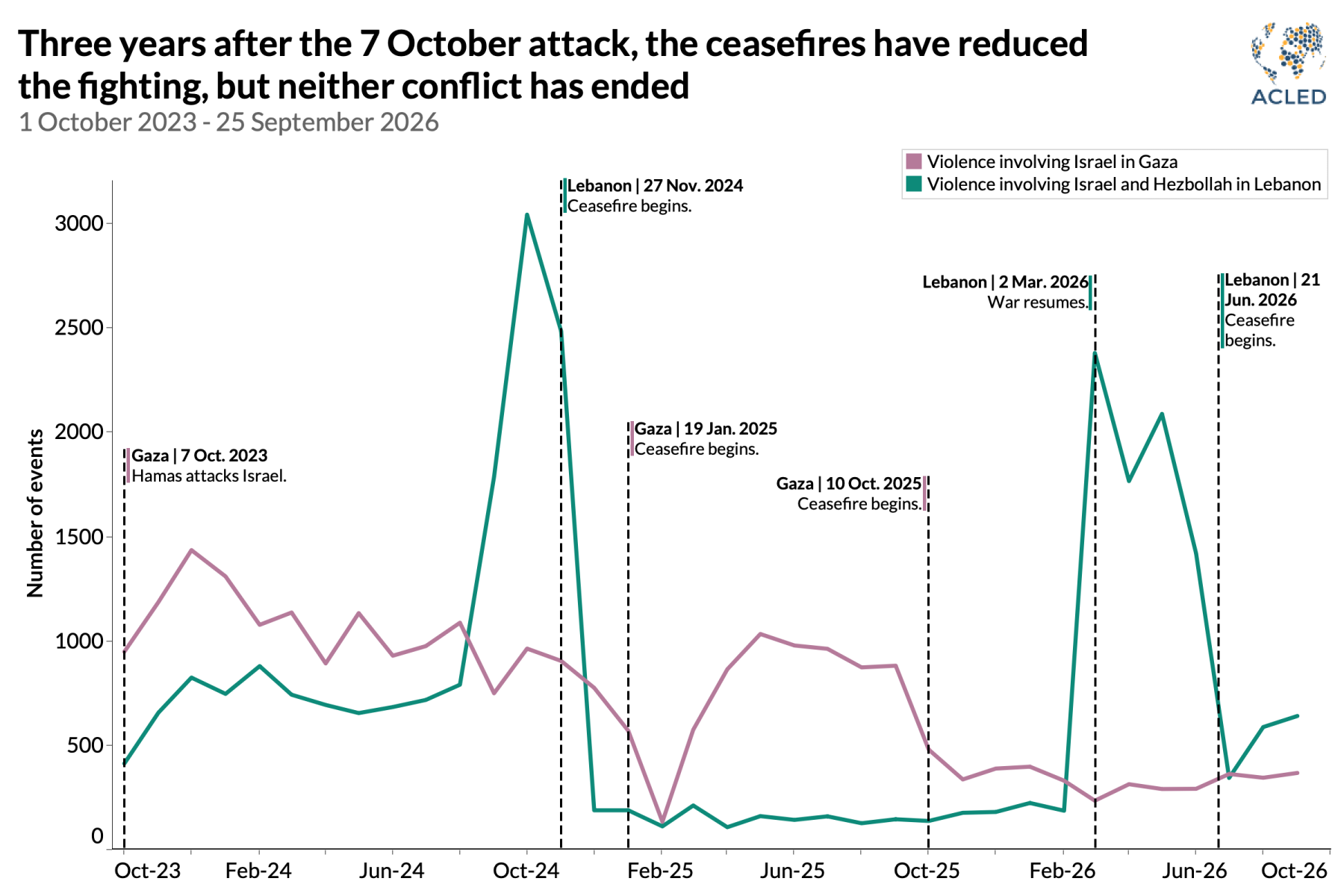
Three years after the 7 October attack, the ceasefires have reduced the fighting in Gaza and Lebanon, but neither conflict has ended. Violence has continued at a lower level despite ceasefires reached partly because of US pressure on Israel.
Nasser Khdour, Middle East Senior Analyst at ACLED, said:
“Three years on from the 7 October attacks that triggered the Gaza war, and as the ceasefire approaches its first anniversary on 10 October, ACLED data show that violence has fallen by 61% compared with the second year of the war. In Lebanon, by contrast, violence reached its highest level since 7 October 2023 after Hezbollah joined the war in support of Iran on 2 March 2026. Violence has declined during ceasefire periods, including after the ceasefire took effect on 21 June 2026 (see graph below).
“Overall, Israel has relied on territorial control to pressure Hamas and Hezbollah to disarm. It was mainly after the launch of Operation Gideon’s Chariots in May 2025 that Israel shifted in Gaza from short raids and withdrawals to holding and expanding territory until their establishment of the Yellow Line1. Israel took a similar approach in southern Lebanon, establishing a buffer zone following the March 2026 war, as efforts to disarm Hezbollah failed. Israel now controls at least 65% of the Gaza Strip and around 6% of Lebanon within the security zone beyond the Yellow Lines.
“The buffer zones’ objective is not only to put pressure on Hamas and Hezbollah. Since ceasefires took effect in both Gaza and Lebanon, Israel has aimed to put pressure on the wider population through evacuations, continued attacks, the destruction of infrastructure, and control over territory. In Lebanon, 73% of the controlled property destruction events recorded since the war began in March happened after the June ceasefire, while in Gaza, 29% happened after the October ceasefire. Meanwhile, Israeli remote attacks and shootings remain concentrated near the Yellow Line in both regions (see map below).
“Israel has also increased its airstrikes ahead of October’s election. Air and drone attacks against Hamas and its members in Gaza continued and peaked in July 2026. Then they declined in August, after Hamas accepted the idea of disarmament and the US pressed Israel to stop its operations. In September, however, airstrikes rose again to around the same level as July. In Lebanon, air and drone strikes have increased since the June ceasefire, with September recording the highest number since the ceasefire agreement (see graphs below).
“Hamas and Hezbollah have largely avoided responding to continued Israeli strikes, despite some scattered incidents — which shows how much the war has weakened them. Both groups have lost much of their senior leadership, commanders, and fighters, while their domestic support is at its weakest point. Hamas has lost much of its rocket arsenal, while Hezbollah relies more on small rockets and individually launched drones to impose costs: neither group can therefore launch a large cross-border attack now.
“Despite their weakened positions, both groups remain active. Hamas is still the dominant Palestinian actor in Gaza, with around two million people living in areas that the group controls; while Hezbollah’s still operate north of the Litani River as they try to rebuild .
“Israel’s October elections could bring a new government and change the timing or intensity of Israeli operations, but are unlikely to alter the country’s broader security and military objectives. Israel continues to see the war as unfinished, remains concerned about renewed threats, and is demanding the disarmament of Hamas and Hezbollah — demands that neither group has fully accepted. With these core disagreements unresolved, Israel is unlikely to withdraw fully, and violence is likely to continue, even if it remains below wartime levels.”
Want to know more? Journalists can contact the ACLED Press Office to arrange interviews or request expert analysis.
Explore our Middle East Conflict Monitor for the latest on the wider region, or browse our specialized data tools.
Not a member of the press? Speak to the team about subscription options and access.
Footnotes
- 1
The Yellow Line is the boundary established under the October 2025 Gaza ceasefire agreement, separating areas controlled by Israeli forces from the rest of the Gaza Strip.


