Expert Comment
Why have water shortages in Mauritius sparked the worst civil unrest in recent years?
Peter Bofin comments on how chronic water shortages and rising living costs have fuelled violent protests across Mauritius, exposing deeper frustrations over inequality and economic pressures.
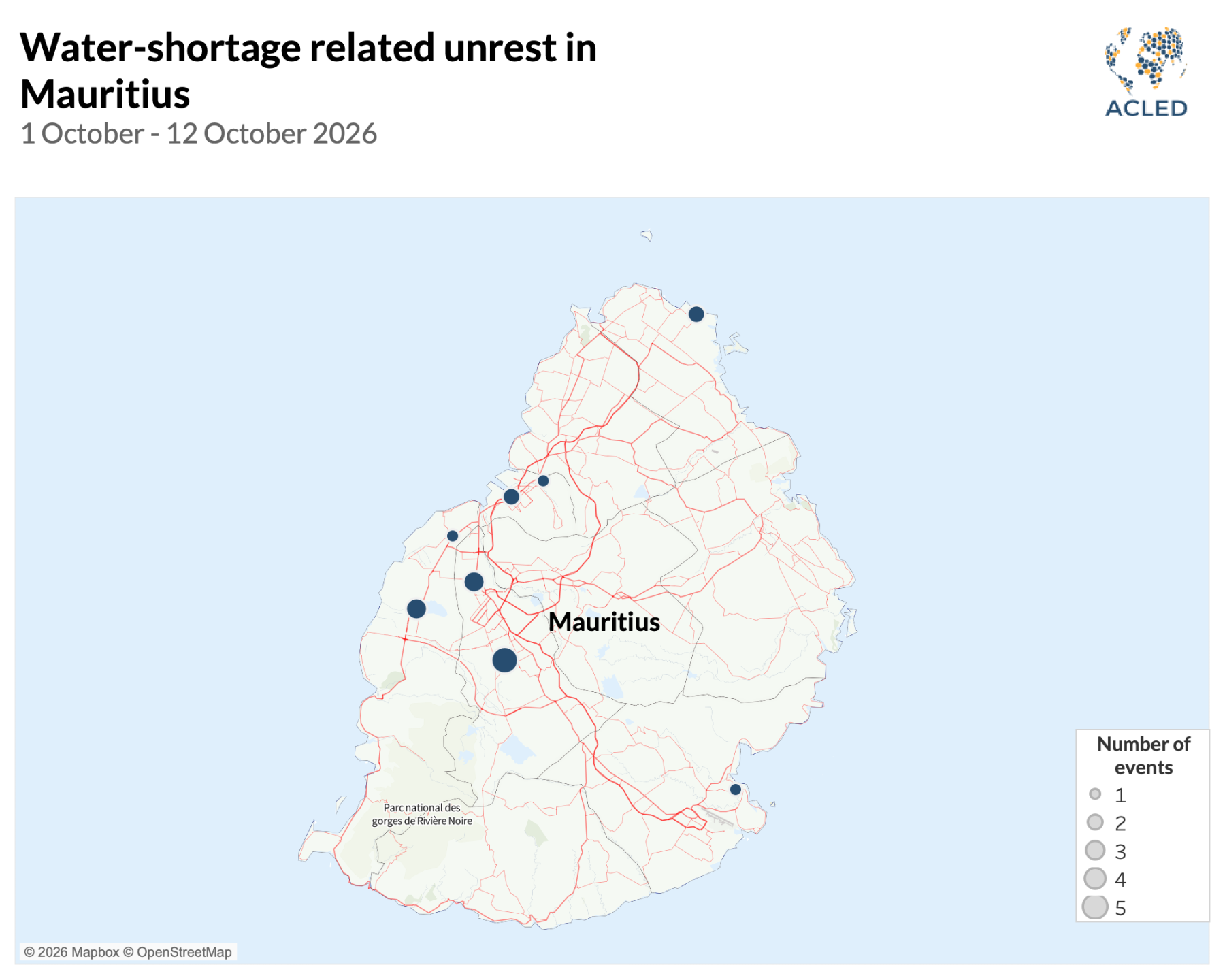
The small Indian Ocean island of Mauritius is being rocked this week by widespread protests, violent demonstrations, and looting. Water cuts in the densely populated areas of Vacoas-Phoenix and Bambous, just south of the capital St Louis, prompted residents to block roads on 5 October. Violence became widespread after police shot and injured a woman on 9 October. Subsequent violence prompted the authorities to announce a curfew, set to be in place until at least 16 October.
ACLED’s Southeast Africa analyst Peter Bofin said:
“Water shortages have been a chronic problem across Mauritius for years. Communities can go without water for weeks and at times months. At ACLED, we have seen public protests in response to water shortages increase steadily since 2020. These have mostly been in small towns far from the capital St Louis.
“Unrest this time has centred on urban areas. In the week since 5 October alone, ACLED records at least 15 events related to the water protests. Over two-thirds of those events have involved violence, ranging from protestors blocking roads, to groups of youths attacking police stations.
“Water cuts of just a few days in the urban communities of Vacoas, Phoenix, and Bambous affected a great number of people. Since the protests started, demonstrators have also highlighted cost-of-living pressures. Water cuts simply added to those pressures.
“Social media too has helped accelerate the protests. The Burning Paradise WhatsApp group has acted as a forum for organizing. Its title also expresses the frustrations of the urban poor in an economy reliant on high-end tourism and international finance.
“The demonstrations seem to be reflecting pent-up frustrations that those in government, and outside government, are not addressing. This coming Saturday, opposition parties and civil society activists had planned a demonstration on pension reform, an issue that won’t address people’s pressing issues.
“In the short term, the authorities should be able to control the violence through security measures. In the longer term, Mauritius may need to rebalance its economy so that the wider population benefits from the invisible export revenue generated by tourism and corporate and financial services.”
Want to know more? Journalists can contact the ACLED Press Office to arrange interviews or request expert analysis.
Explore our Latin America & The Caribbean page for the latest on the wider region, or browse our specialized data tools.
Not a member of the press? Speak to the team about subscription options and access.