Report
De la Espriella's inauguration will test the new Colombian president's approach to dissent
If the new administration cracks down on protests, tensions could escalate in the streets.

Executive Summary
Abelardo de la Espriella’s term as president of Colombia will likely face demonstrations from Day 1. Outgoing President Gustavo Petro continues to claim fraud in De la Espriella’s razor-thin victory margin against leftist candidate Iván Cepeda, and Cepeda has already called for civil disobedience against the incoming government. In turn, De la Espriella has promised to crack down on protesters — heightening the risk of recreating the conditions for the kind of turmoil that the country experienced in 2021 under the conservative government of Iván Duque, when security forces harshly repressed anti-government protests.
Both the new government and opposition are likely to hold their ground and test their political strength. Some opposition-led demonstrations are most likely to arise around De la Espriella’s inauguration on 7 August, but the risk of unrest extends beyond the immediate. De la Espriella’s policy agenda will face harsh resistance from Petro’s and Cepeda’s party — the largest force in Congress — as well as allied social movements, particularly in the departments where Cepeda obtained more votes, including Cauca, Valle del Cauca, and those along the Caribbean coast.
Hardened stances by both the incoming and outgoing governments risk reopening the wounds of the 2021 protests
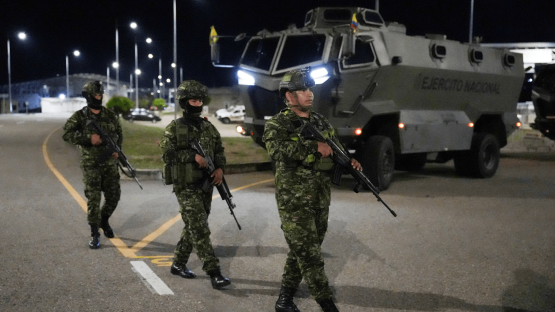
De la Espriella starts his term amid sky-high tensions with the outgoing government. Petro has warned that De la Espriella will not be able to finish his mandate due to popular pressure, while his ally Cepeda has said he will organize a series of protests on inauguration day in Bogotá, Barranquilla — which De la Espriella has promised to recognize as an alternative capital — and Cali, where the incoming president has opted to be sworn in. Although both Petro and Cepeda have called for these gatherings to be peaceful, the doubts they have cast on the legitimacy of De la Espriella’s presidency are likely to create the conditions for violent demonstrations. De la Espriella’s inflammatory rhetoric is not helping defuse tensions either: He has defined the demonstrations invoked by Cepeda as “urban terrorism” and threatened to use force against those who violate the law. In addition, both De la Espriella and Petro have called for creating communal militias to combat urban crime and counter politically motivated “assassins,” respectively.
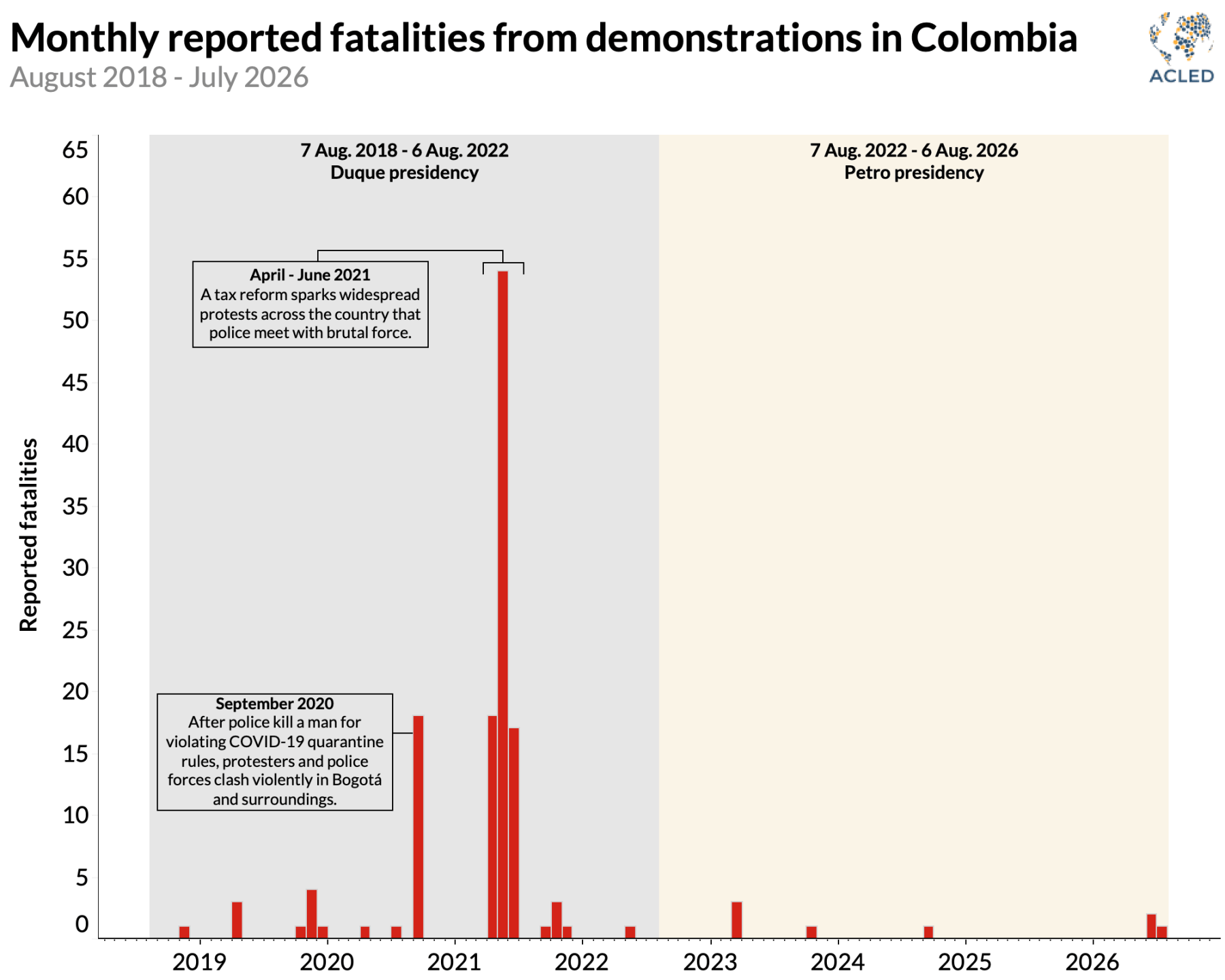
The combination of calls for mobilization and threats to use force creates an explosive mix that risks creating conditions reminiscent of the widespread unrest that rocked the Duque administration, which culminated in the 2021 national strike. At the time, social discontent, corruption, and a tax reform triggered the protests, but it was the deadly repression of demonstrations that followed that made unrest spread in space and time. The crackdown led to the deaths of almost 90 people (see graph below), more than half of them in Cali. Most protesters’ deaths came at the hand of security forces, particularly the Mobile Anti-Disturbance Squad (ESMAD), a unit that was repurposed by Petro and re-oriented toward dialogue with protesters, but which De la Espriella has promised to reinstate. The turmoil, which paralyzed parts of the country for several weeks, not only had a major economic impact (around 3 billion USD), but also brought about the demise of the Duque government and contributed to the rise of Petro’s Humane Colombia political movement.
Outlook: The risk of unrest extends beyond inauguration day
De la Espriella’s presidency is likely to meet significant anti-government mobilizations right away. How he responds to the Cepeda-led protests will not only signal his government’s approach toward dissent, but also influence the evolution of unrest in the country. If De la Espriella adopts a confrontational approach, initial gatherings are likely to turn into more structured and widespread social resistance movements, heightening the risk of clashes with both security forces and De la Espriella’s supporters. Demonstrations around the inauguration in Cali — where a few violent protests led by Cepeda supporters rejecting the election results took place in June — are particularly important to watch.
But even if the initial mobilizations fade quickly, the package of 90 decrees De la Espriella plans to introduce in his first 100 days in office risks sparking further unrest. Should De la Espriella push to pass reforms that halt or even undo Petro’s social reforms and peace efforts, he will face strong opposition both in Congress, where Petro’s party is the main political force, and in the streets. This is particularly true for conflict-ridden departments where support for Petro and Cepeda runs high, such as Cauca, Valle del Cauca, and those along the Caribbean coast (see map below). These areas, along with Bogotá, will also be the most exposed to renewed repression of a reinstated ESMAD.
Visuals produced by Ana Marco.