Report
Despite its rejection of the second phase of Trump’s peace plan, Israel will make minor concessions under US pressure
Disarmament is unlikely as long as Israel maintains a presence along the Yellow Line and continues targeting Hamas’ military and security structures ahead of national elections.
Executive summary
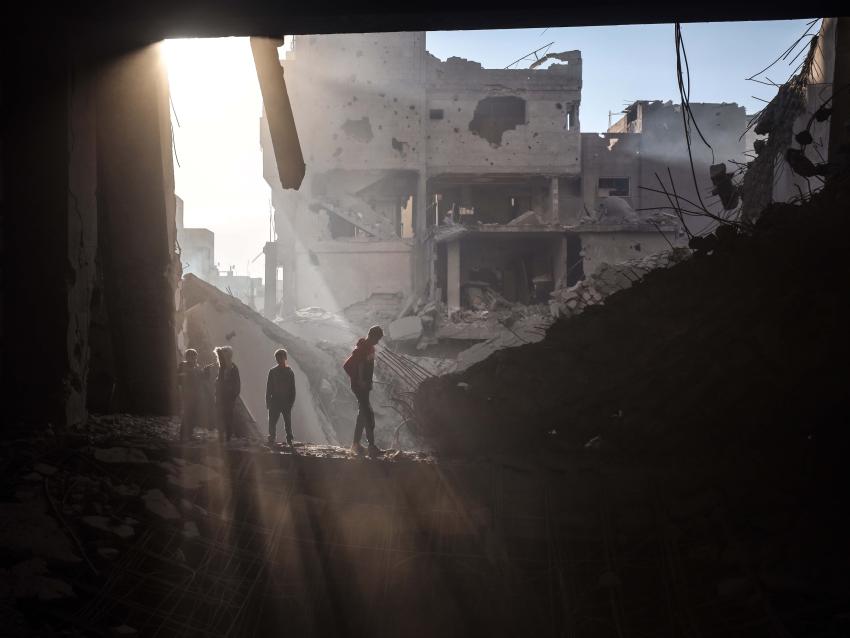
Even though Hamas and Israel agreed to the October 2025 ceasefire, Israel has carried out sustained military activity in Gaza. It has pursued an escalating campaign of airstrikes targeting Hamas militants and continued to target Hamas’ security structures. At the same time, the Israel Defense Forces (IDF) has continued to push the bounds of the Yellow Line, around which violence remains concentrated.
While Israel has publicly rejected the Board of Peace’s 15-point peace plan for Gaza, some limited changes are likely in the near term under pressure from the United States. Israel is likely to reduce the intensity of targeted attacks west of the Yellow Line. However, Israeli withdrawal is unlikely as long as Hamas and other armed groups remain active, no alternative security arrangement is reached, and domestic political pressure remains high ahead of the Israeli elections.
Israel’s air- and drone attacks against Hamas escalate in an attempt to weaken its security forces
Israel has increasingly targeted Hamas and other armed group militants as part of a sustained month-on-month escalation in strikes since the start of the year. Despite the ceasefire signed in October 2025, weakening the group’s military and security structures has remained a central war objective for Israel and a major obstacle to implementing Trump’s proposed peace plan. Between 10 October 2025 and 14 August 2026, Israel has launched around 200 strikes that have hit militants, including commanders involved in planning the 7 October attack; fighters who infiltrated Israel that day; and operatives involved in rebuilding military capabilities (see graph below). Nearly 60% of these strikes have occurred between May and July, with July recording the highest number. At the same time, Israel has continued to target the security structures that help Hamas maintain control inside Gaza. It has carried out at least 38 air- and drone strikes on police officers, police stations, members of the Sahm and Radea security force units, and other security personnel.
Since early August, however, targeted assassinations slowed amid increased US pressure on Israel. ACLED doesn’t record any incidents between 3 and 11 August. On 12 August, the Israeli Air Force targeted and killed a Hamas commander, the first such strike in about a week, followed by another strike on 13 August that killed a senior police official.
Israel has made the pursuit of militants involved in the 7 October attack a long-term security priority. Israel’s Shin Bet has set up a dedicated unit to track militants using facial recognition and AI tools. The effort is tied both to Israel’s attempt to maintain deterrence and to the continued political and security impact of the 7 October attack, which is seen as a major intelligence and security failure. Agreeing to Trump’s 15-point plan would require Israel to immediately stop targeting Hamas leaders and militants. In practice, however, this would mean Israel has not achieved its stated goal of eliminating Hamas, particularly those involved in the 7 October attack.
Israel expands westward as it fears Hamas will remain a key actor
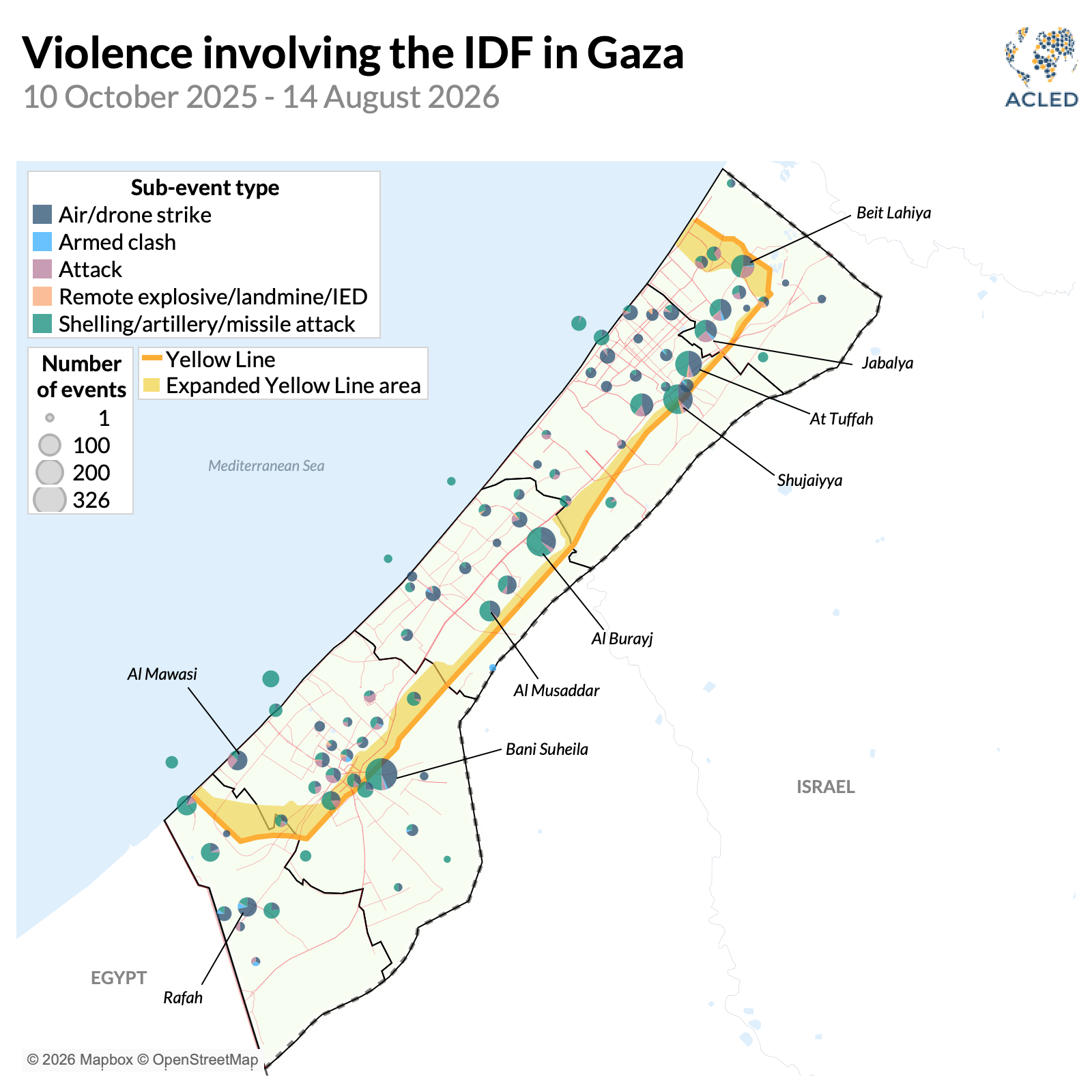
Israeli forces have been expanding westward since the October ceasefire to increase pressure on Hamas, which has become a key obstacle to further withdrawal. While Israel’s presence along the Yellow Line was meant to be temporary, given that further withdrawals were planned under Trump’s plan, the share of Gaza territories under Israel’s control increased from around 53% in October 2025 to about 65% by the end of June. ACLED data show further westward expansion as Israeli forces have placed concrete blocks marking the Yellow Line in at least nine locations, most recently on 7 August. This expansion has continued alongside sustained fire from drones, tanks, crane-mounted weapons, and direct gunfire at people or militants approaching the Yellow Line. Around 80% of incidents involving Israeli forces have occurred near the Yellow Line (see map below). ACLED data show that these incidents declined slightly between 2 and 7 August before rising again between 8 and 14 August. Since then, violence near the Yellow Line has continued, linked to the IDF, its westward expansion, and fire at people and militants approaching the area who are seen as threats.
Outlook: Israel seems to be scaling down its attacks while maintaining its position along the Yellow Line
Israel’s refusal to withdraw from Gaza will impede progress on Hamas’ disarmament and the wider peace plan. However, it faces a balancing act to keep the US on side, which is likely to result in some short-term changes. Israel is likely to reduce the intensity of its attacks in Gaza in the near term as President Donald Trump’s pressure on the Israeli government increases ahead of the US mid-term elections. The slowdown in targeted assassinations suggests that this pressure has already limited Israel’s targeted attacks west of the Yellow Line.
However, Israel is unlikely to stop these attacks completely, and further strikes should be expected as Israel’s elections on 27 October draw closer. Furthermore, progress on any Israeli withdrawal will remain unlikely ahead of the national elections and while Hamas and other armed actors remain active. Israel’s slow westward expansion is likely to continue alongside ongoing violence near the Yellow Line.
Factors shaping Israel’s next steps
US pressure and involvement: US pressure on Israel to limit operations and keep the second phase moving is likely to remain strong through the midterm elections. However, disarmament is a long process that will take time, and if US pressure weakens after the elections, Israel will have more room to increase attacks.
Security conditions and Hamas’ position: Hamas is unlikely to reverse its position on disarmament as the Israeli national elections approach. Its acceptance of disarmament has come under sustained pressure from the Israeli military and the threat of further escalation, including the threat of an intense campaign of targeted assassinations against its members ahead of the elections
Israeli elections and domestic pressure: Domestic politics are likely to constrain Israel’s withdrawal from Gaza. Pressure from coalition partners and political opponents could make both withdrawal and a complete halt in attacks in Gaza harder while Hamas and other armed groups remain operational.
Visuals produced by Ana Marco.
Restricted page:
Gaza Conflict Monitor
ACLED’s Gaza Conflict Monitor maps political violence and property destruction events in Gaza, as well as attacks originating in Gaza targeting Israel, since the current conflict began on 7 October 2023.
Explore further