Militant Islamist groups
Report
Down but not out: The Islamic State and al-Qaeda remain a threat in the Middle East
Amid counter-terrorism operations across the region, jihadist groups are regrouping and shifting strategies.

✓ ACLED is the world’s most trusted source of conflict information >
Although overshadowed by the United States and Israel’s war on Iran, jihadist groups in the Middle East pose an enduring, if diminished, threat to regional stability. In Syria, Iraq, and Yemen, kinetic activity contracted by approximately 44% in the first seven months of 2026 compared to the same period last year. While none of these groups control large swathes of territory as they did a decade ago, or as some of their African affiliates do today, they continue to survive amid operational and environmental constraints and are recalibrating their targets.
Across the region, counter-terrorism operations, backed by international partners, have curbed the territorial ambitions of al-Qaeda and the Islamic State of Iraq and the Levant (ISIL). From Syria and Iraq to Yemen, the establishment of a caliphate or an emirate represents a distant reality. However, faced with growing pressure, jihadist groups have shifted their focus to sustaining low-level insurgencies, conducting ideological influence operations, and engaging in long-term reconstitution. The fragility of domestic transitions in all these countries, along with a turbulent regional environment, positions these groups to exploit any instability. At the same time, their links with global militant, recruitment, and financing networks represent a threat that transcends the Middle East.
Syria
Risk profile
- Weakened and unable to pursue territorial goals, ISIL is likely to focus on sporadic bombings targeting high-profile or symbolic locations in urban settings, including religious and minority-linked sites, government facilities, and densely populated public areas.
- The group has also increasingly emphasized its fight against the Syrian state. Despite facing heightened pressure from the Syrian government’s counter-terrorism operations, ISIL attacks against religious minorities and plots against senior political and military figures aim to undermine the government’s legitimacy and its grip on security. Its infiltration of the security forces further compounds the threat of insider attacks.
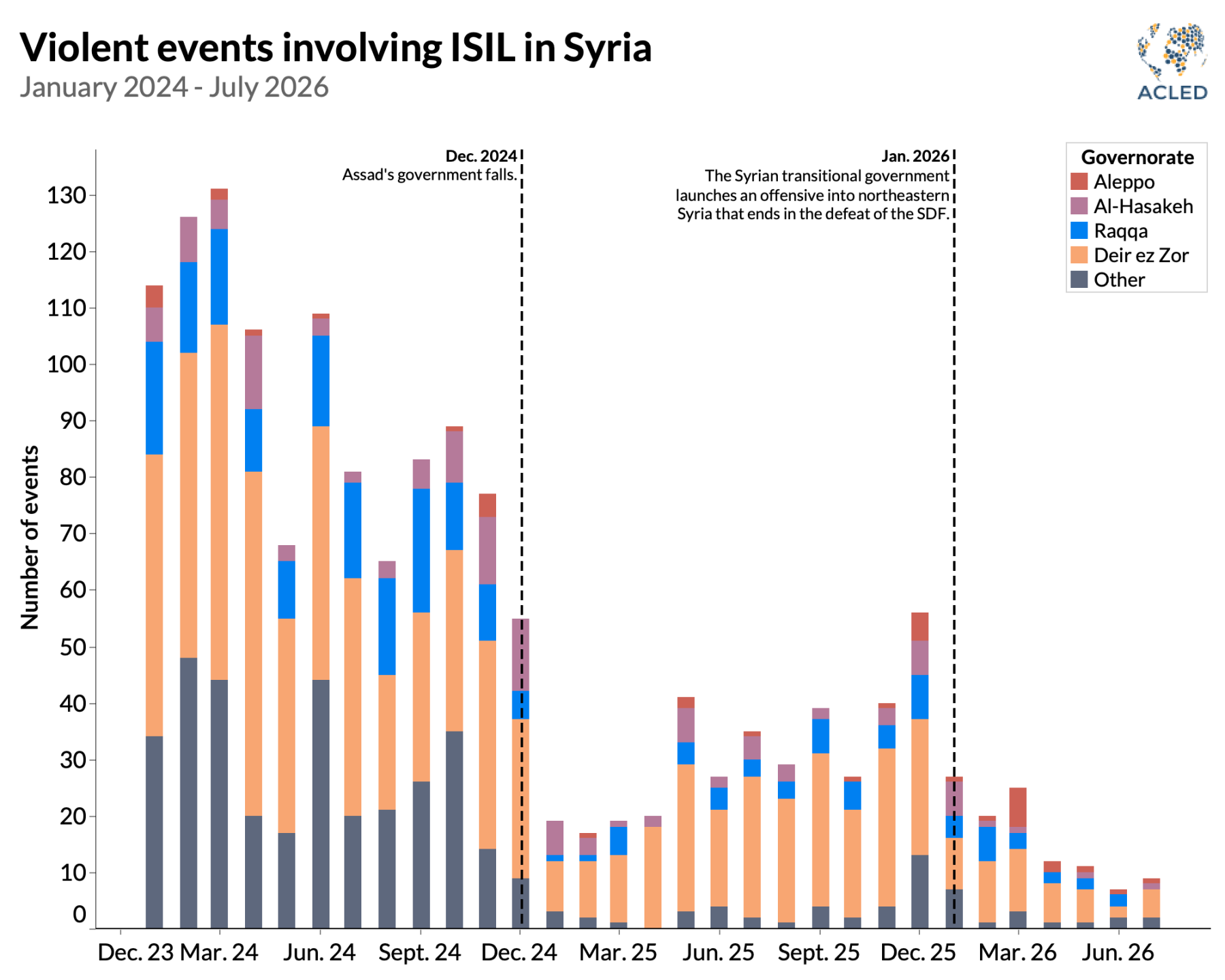
ISIL activity in Syria has declined in 2026, contracting from an average of 29 events per month in 2025 to around 14 in the first seven months of 2026. Since the fall of Bashar al-Assad’s regime in December 2024, ISIL operations have shifted geographically from the eastern countryside of Deir ez-Zor controlled by the Kurdish-led Syrian Democratic Forces (SDF) and the vast desert Badia region across the border between Iraq and Syria, to urban centers, where they are more vulnerable to the new Syrian government’s counter-terrorism efforts. Today, ISIL is estimated to have between 2,500 and 3,000 fighters operating in small cells embedded across the country.
ISIL’s strategy has changed since January 2026, when the Syrian government launched an offensive against the SDF. The campaign ended with the defeat and integration of the Kurdish-led forces, once the main actor in the fight against ISIL, into Syria’s state structures. In turn, the United States began withdrawing its troops from Syria and handing over all major bases to the Syrian government in April. The SDF’s loss of control over northeast Syria, along with its integration into state institutions, represents a setback for ISIL, which had long exploited resentment of the SDF’s dominance among the northeast’s Arab tribes to bolster recruitment and support (see chart below). ISIL has since turned increasingly against the Syrian government, announcing a “new phase” of operations and calling on its fighters to target the “apostate” government in Damascus in February. The group has subsequently targeted Syrian government forces in at least 61 events, resulting in 50 reported fatalities.
Taken together, these developments have weakened ISIL, but not eliminated its threat. The authorities' counter-terrorism capabilities are partly rooted in the operational experience that Hayat Tahrir al-Sham (HTS) acquired while governing Idlib, where it built capacity designed to detect ISIL networks, prevent planned attacks, and dismantle militant cells. These capabilities have since been extended across the country through targeted raids, weapons confiscations, and the disruption of several assassination attempts against government figures. The sudden closure of the camps housing families of alleged ISIL affiliates in the wake of the SDF’s defeat, and the potential movement of foreign fighters in and out of Syria, will test the government's ability to prevent the resurgence of ISIL.
Although counter-terrorism efforts have become more effective, the possibility of bombing and hit-and-run attacks by ISIL, other extremist groups, or loosely connected individuals persists. On 7 July, two bombs went off in Damascus, near the Ministry of Tourism and a hotel hosting French President Emmanuel Macron on an official visit to Syria, killing one person and injuring dozens. Syrian authorities blamed ISIL for the attack and announced the arrest of all members of a militant cell that had staged another bombing outside a Syrian Defense Ministry building. The attack overshadowed Macron’s visit to Syria and raised questions about the government’s ability to prevent terrorist attacks in the capital.
Future terrorist attacks should be expected to target high-profile or symbolic locations, including religious sites (such as the Mar Elias Church in Damascus, struck by an ISIL bombing in June 2025, or the Alawite Imam Ali ibn Abi Talib Mosque in Homs, targeted by the ISIL-linked Saraya Ansar al-Sunnah in December), government facilities, and densely populated public areas. Further compounding these risks, some ISIL elements are reported to have infiltrated security forces, as demonstrated by an ISIL-claimed attack carried out by a Syrian police member against a joint Syrian army-US delegation in Tadmor in December 2025.
Iraq
Risk profile
- ISIL activity in Iraq has reached an all-time low. Operationally limited, but maintaining a dispersed presence in Iraq’s western governorates, ISIL has the capacity to carry out sporadic IED attacks against military patrols and occasional attacks against civilians.
- Increased strain on Iraq’s prison system following the repatriation of thousands of detainees from Syria, along with regional instability, points to a potential threat of mass jailbreaks that would likely reinforce ISIL numbers in Iraq and across the region.
US troops are poised to exit Iraq on 30 September, ending a 23-year military presence that began with the invasion of Iraq in 2003 and shifted toward combatting the Islamic State in 2014. US forces fully withdrew from the Ain al-Asad base in western Iraq in January following an agreement with the Iraqi government, and only a small contingent of US military advisers and personnel remains in the country.
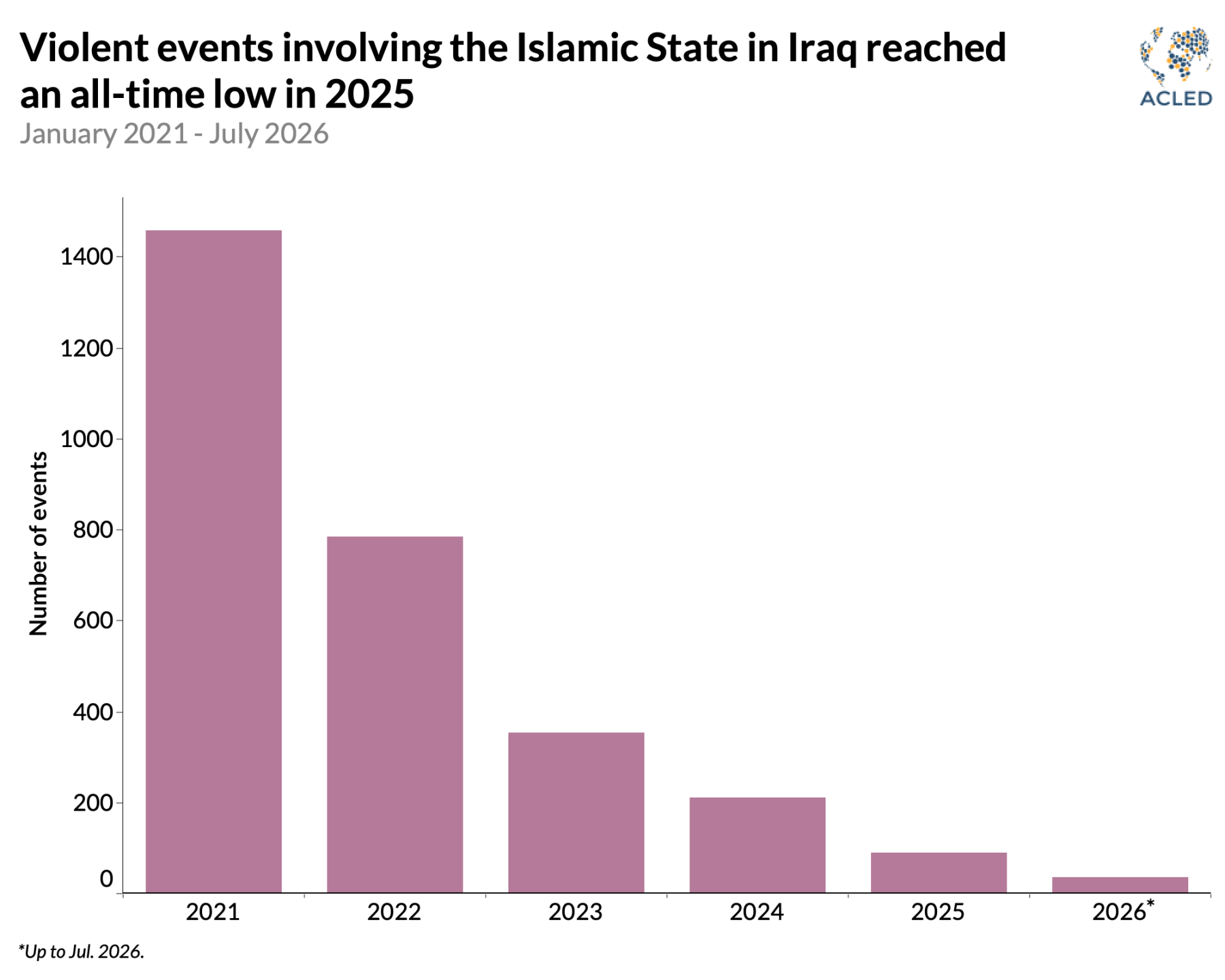
The US departure from Iraq comes at a time when ISIL has significantly contracted its activity. The number of events involving the Islamic State reached an all-time low in 2025, decreasing to 88 from an estimated 1,457 in 2021 (see chart below). ISIL claims also dropped to only two during the first half of 2026, compared to over 1,000 in 2021. Its presence is largely confined to a limited number of strongholds in al-Anbar, Ninewa, and Salah al-Din governorates and in the Hamrin mountains of Kirkuk governorate. Unlike in 2018 and 2021, ISIL did not carry out any attacks during the Iraqi parliamentary elections in 2025.
A combination of factors helped defuse ISIL’s threat in Iraq. Several Iraqi governments have committed to sustained counter-terrorism efforts, coordinating with Kurdish authorities and international partners. Local communities that once lived under ISIL have become much less permissive, shrinking its recruitment pool and support base. The new Syrian government has also ramped up its efforts against ISIL.
Yet, while significantly weakened, the group remains a concrete threat to Iraq’s and regional stability. ISIL has adapted to a hostile environment, operating as a network of active and insurgent cells to withstand intense counter-terrorism efforts. Sporadic yet lethal IED attacks against military patrols and occasional attacks against civilians, including kidnappings, characterize ISIL’s new reality in Iraq. Indeed, ISIL could capitalize on regional instability. Iraq’s new government, headed by Ali al-Zaidi, finds itself sandwiched between the US and Iran, which both supported its appointment but continue to be at war. Tensions within the government and with the Iran-backed militias could weaken ongoing counter-terrorism efforts.
The repatriation of 5,700 detainees from Syria, after the January 2026 offensive against SDF, has placed pressure on Iraq’s overcrowded prison system. Regular protests are held at detention sites to denounce the conditions of prisoners, while the Islamic State’s propaganda outlet, al-Naba, has condemned Iraq’s prison system for its sectarian nature. A jailbreak of convicted militants set off by a targeted attack or a security incident, like the drone strike in March that just missed a prison hosting thousands of ISIL detainees transferred from Syria, could potentially play in the group’s favor.
Yemen
Risk profile
- AQAP remains one of al-Qaeda’s most significant affiliates, staging a low-level insurgency inside Yemen and enabling exchanges of weapons and expertise across the Red Sea.
- Domestically, AQAP has adopted a wait-and-see approach while retaining the ability to carry out targeted attacks against members of the security forces. Despite intense pressure from counter-terrorism operations, AQAP has exploited the security vacuum that followed the January crisis to upgrade its arsenal and further embed itself within Yemen’s social fabric.
After the dissolution of the Southern Transitional Council (STC) in January 2026, al-Qaeda in the Arabian Peninsula (AQAP) has adopted a “wait-and-see” approach, exploiting a lull in coordinated counter-terrorism operations — once spearheaded by the STC — to regroup, recruit, and consolidate its presence. Strategic continuity has indeed defined the leadership of Saad bin Atif al-Awlaqi, who assumed power after Khalid Batarfi’s death in March 2024. Under al-Awlaqi, AQAP has engaged in a low-level insurgency against forces affiliated with the STC and the internationally recognized government, while pursuing active cooperation and non-belligerence with the Houthis and other extremist groups, chief among them al-Shabaab.
Overall, AQAP’s activity in the first seven months of 2026 decreased by an estimated 70%, from 63 events in the same period of 2025 to 19 in 2026. Reading this lull as a sign of weakness would be a mistake. AQAP retains the ability to carry out lethal hit-and-run operations, while an uptick in its propaganda production suggests an ongoing attempt to co-opt and embed itself within Yemen’s southern tribes. The group relies on a fighting force comprising around 2,000 fighters, mostly entrenched in the rugged mountains between Abyan and Shabwa. AQAP cells and operatives are also reported to be present in Aden, Marib, Hadramawt, and al-Mahra. Earlier this year, some of these governorates were the target of US airstrikes on AQAP fighters.
Car bombs and sniping attacks, which defined AQAP’s operations in 2024 and 2025, have been replaced by “riding-in-tandem” shootings. AQAP hitmen on motorcycles carried out at least three successful assassination attempts between January and June 2026. All assassinations took place in Mudiya district, AQAP’s stronghold situated to the north of Abyan governorate, and targeted officers of the STC, National Security Forces, and the Giants Brigades. On 14 July, the National Security Forces — a police unit consisting of former STC security forces — fended off another attack carried out by AQAP militants with machine guns and hand grenades in the neighboring district of Lawdar.
Yet, AQAP has also actively exploited popular resentment with the STC and government-affiliated forces to bolster recruitment. In recent years, the arbitrary detention of tribesmen suspected of collaborating with AQAP sparked public condemnation from the tribes and led to several clashes with pro-STC forces. In turn, AQAP has released confession videos featuring alleged STC spies to discourage cooperation with counter-terrorism forces and co-opt the tribes, or at least ensure their neutrality. The group has also engaged in social activities, including holding public Eid al-Adha prayer sessions in its stronghold of Mudiya and charitable initiatives, including in Hadramawt. The launch of a new weekly newspaper, al-Bayan, further reveals AQAP’s ambitions to assert its leadership on al-Qaeda’s global militant network.
In parallel, AQAP has increasingly assumed the role of a regional facilitator, acting as a broker between the Houthis and al-Shabaab. AQAP’s expanding control over Abyan's southern coastline, where it has not faced sustained counter-terrorism pressure, has positioned the group to assume this role. This presence, coupled with the group’s growing use of drone technology since mid-2023 (see chart below), allows AQAP to facilitate transfers of drone technology and expertise to jihadist groups in the Horn of Africa.