
Report
As drone attacks on Ukraine intensify, Eastern Europe is straining to counter the spillover
While Russia and Ukraine attempt to destroy each other’s energy infrastructure and export capacity, continued drone spillover is likely.

Executive summary
Following an intensified wave of Russian attacks on Ukraine’s Black Sea and Danube ports in recent months, stray drones and their remnants fell or were found in Romania, Bulgaria, and Moldova, underscoring the danger of drones straying into Eastern Europe and raising defense costs for frontier states that have to shoot them down.
While affected countries, including Romania, have attempted to improve their aerial defense, Russia and Ukraine’s use of aerial warfare, along with limited anti-drone capacity in Eastern European Union member states and Moldova, leaves them particularly exposed to material damage and disruption over the next three months.
Increased aerial attacks in Ukraine and Russia are leading to drone incursions into Eastern Europe
In the past three months, NATO’s Eastern European states, including Romania, Bulgaria, Latvia, and neutral Moldova, faced an increasingly high number of incidents of drones or drone remnants falling in their territories, coasts, and exclusive economic zones (EEZ). In over 80 drone-related events in 2026 so far, they have scrambled to respond with air policing resources helmed by NATO and national defusal teams both on land and at sea.
The majority of events have occurred in Romania, amid the current escalation in Black Sea warfare between Russia and Ukraine. Here, drones have primarily affected Tulcea, Constanța, and Galați counties (see map below), causing damage to the environment and residential areas and forcing the closure of beach resorts on several occasions. Among the events there, a Russian drone crashed into an apartment building in the southeastern city of Galați, injuring two civilians, and a Ukrainian naval drone detonated in the key Black Sea port of Constanța.
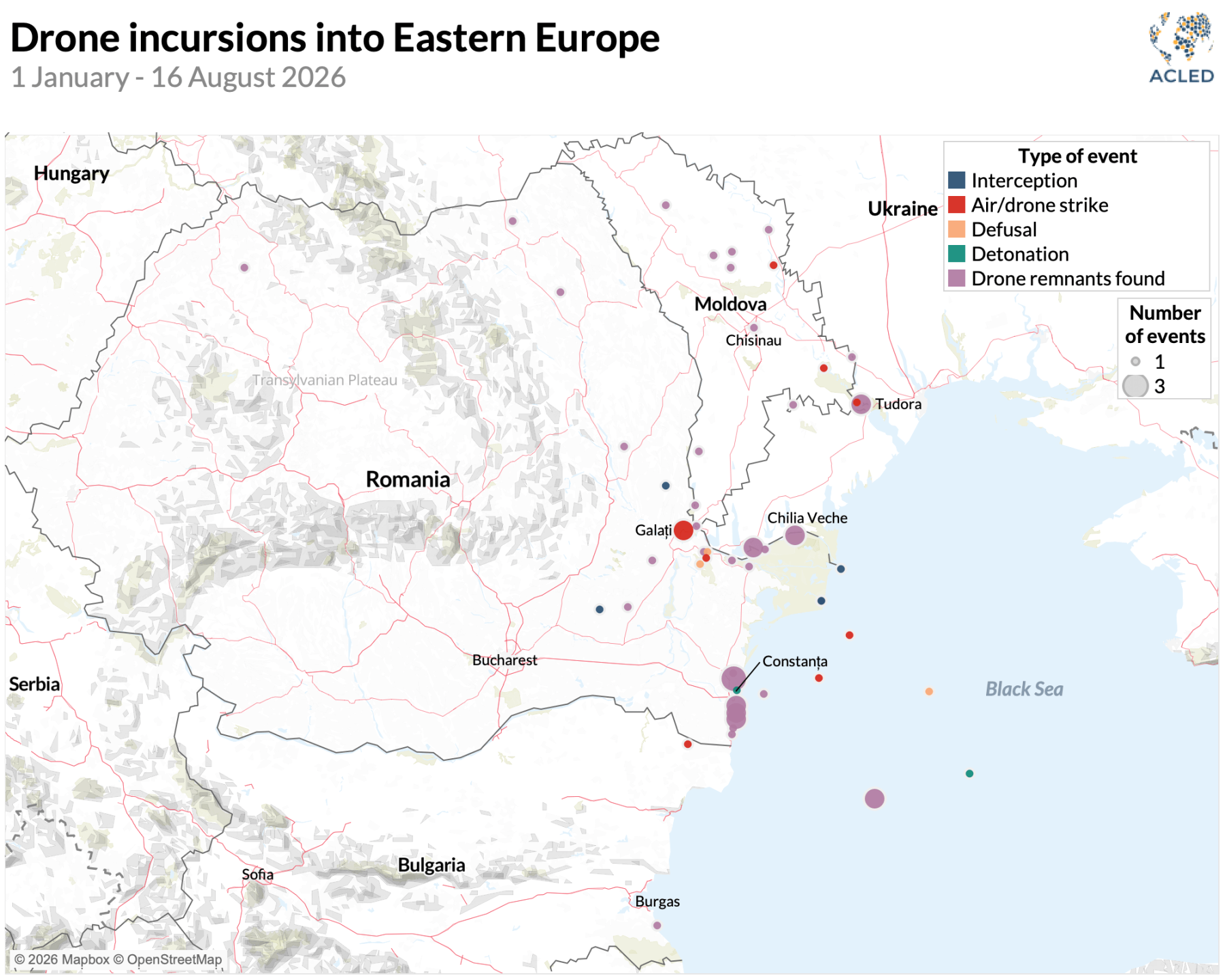
Further strikes have also hit targets in Romania’s EEZ. In July, two Russian drones hit an LPG tanker and a coal cargo ship, forcing Romanian rescuers to save the crews operating the Ukraine-bound vessels. In response, Romania has accelerated the integration of the MEROPS anti-drone system in its air defense, improved coastal monitoring capabilities with uncrewed systems, and begun intercepting Russian drones with its fighter jets and those of its allies.
Bulgaria has also raised alarms about its own security after a Ukrainian decoy drone crashed near a key gas pipeline in the Dobrich province and a Russian reconnaissance drone washed up on its southern shore in early August. Meanwhile, Russian drones or drone-carried missiles entered Moldovan territory and airspace at least 17 times in 2026. Unlike NATO member countries, Moldova has no current capacity to counter incoming drones, including over the uncontrolled Transnistrian region.
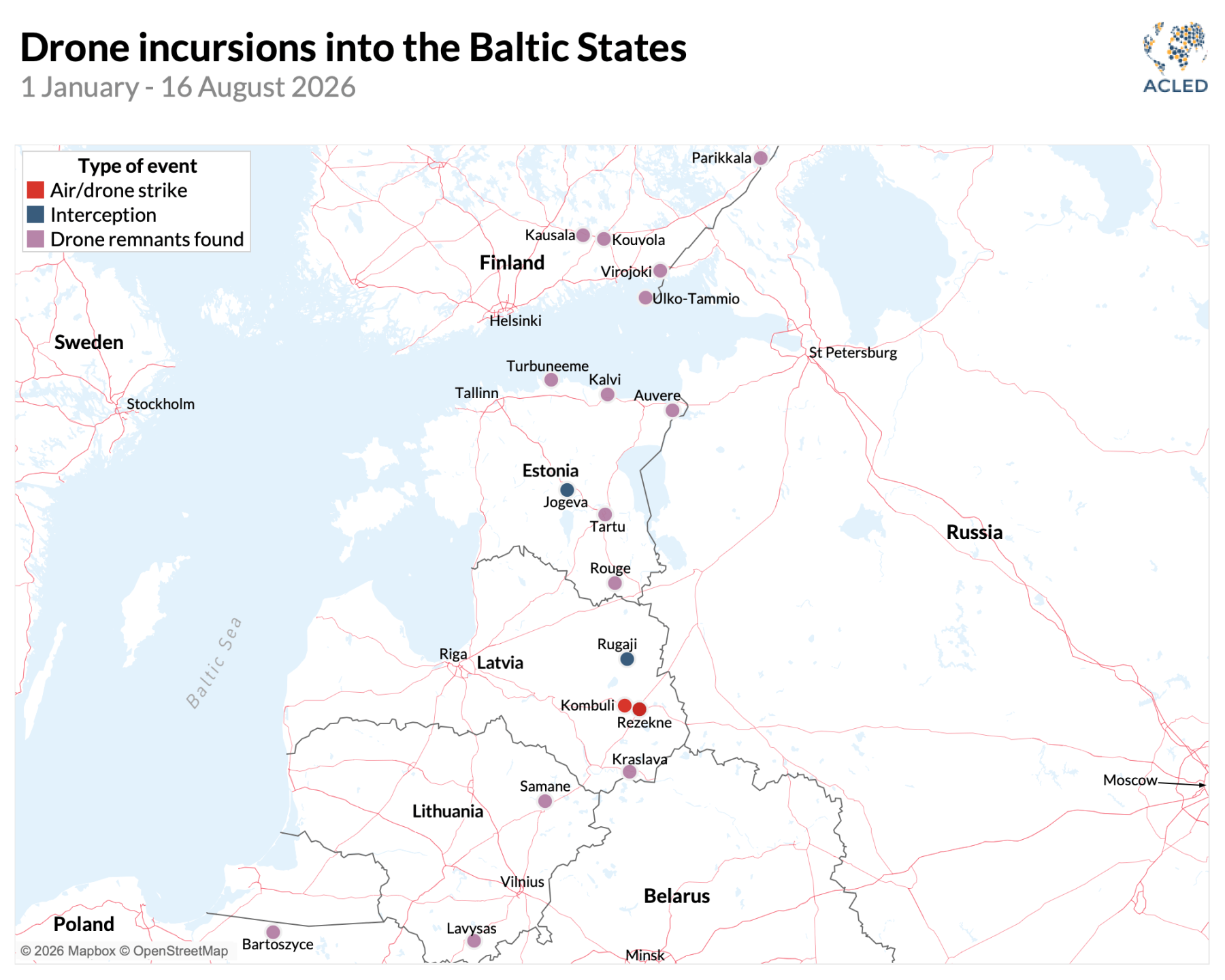
While not entirely spared from Russian drones straying into their territories, Estonia, Latvia, Lithuania, and Finland have been especially affected in 2026 by material damage caused by Ukrainian drone overflights and accidental landings (see map below) as Kyiv increased its strikes on the Russian Baltic Sea ports. In Latvia, where the failure to intercept Ukrainian drones that caused a fire at an oil facility served as a pretext to dissolve the country’s government coalition, a NATO Air Policing Mission has been the main air defense vehicle for countering drone incursions. Finland also had to occasionally impose temporary restrictions on aviation and maritime traffic in its vicinity during Ukrainian attacks on Russia, fearing electronic interference that could redirect Ukrainian drones toward its territory and coast. For its part, Kyiv has apologized to the Baltic states and has offered to improve communication with its Baltic and Black Sea supporters about risks posed by uncrewed systems attacks.
Outlook: Despite improved air defense, Romania and Moldova are the most vulnerable to spillover from Russian drone attacks
Russia’s massive drone attacks on Ukraine and Ukraine’s long-range attacks on Russia are likely to continue as long as drone-producing capacities, financing, and weather are favorable. Southeastern Romania, including its Black Sea coast, EEZ, and Danube Delta ports; Moldova’s entire territory; as well as municipalities in Estonia, Latvia, and Lithuania bordering Russia and Belarus, remain at continuous risk of frequent drone incursions capable of causing infrastructure damage and endangering civilians.
This persistent threat to the security of these frontier states at sea, on land, and in the air will increase the need for NATO’s air policing missions and air forces. It remains unclear whether NATO and the EU can afford to scale up and improve air defense measures calibrated for drones amid the threat of the US withdrawing its troops from the region, public pressure, and Russian saber-rattling in the next few months. Standing in the immediate vicinity of Russian barrages on Ukraine’s export routes, Black Sea littoral states such as Romania, and virtually defenseless Moldova will remain the most vulnerable to material damage and airspace violations from stray drones.
Related content


