
Report
Houthi gains around Bab al-Mandab raise risks to Red Sea shipping and global oil markets
Houthi gains in Yemen and renewed attacks targeting Saudi Arabia raised risks to Red Sea shipping, energy infrastructure, and oil markets.


Executive summary
The Houthis’ recent territorial gains and renewed confrontation with Saudi Arabia have made the conflict in Yemen an increasingly significant source of risk to Red Sea shipping and global oil markets. Their stronger position around Bab al-Mandab comes as Saudi energy infrastructure and export routes are already under pressure from the wider regional conflict. The Houthis are using this position through calibrated coercion rather than maximum disruption: Attacks on Saudi Arabia have intensified and expanded geographically, while maritime targeting remains largely focused on Saudi-linked shipping. This raises military, economic, and negotiating pressure on Riyadh while limiting the risk of a broader international response. The threat to shipping nevertheless remains persistent, as the Houthis retain both the capability and the willingness to widen maritime targeting if the confrontation escalates.
Over the next three months, the Houthis are likely to retain most of their September gains, although consolidating them will remain difficult as resistance strengthens around key highland positions. Saudi-Houthi strikes are likely to continue, while foreign involvement remains predominantly defensive for the time being. Even if maritime targeting remains selective, continued Houthi pressure will sustain risks to Saudi energy infrastructure and Red Sea shipping. Renewed Saudi-Houthi negotiations could restore some restraint, but the Houthis’ stronger military position is likely to make agreement more difficult.
Houthi gains around Bab al-Mandab are significant but difficult to consolidate
Following months of low-level fighting that began escalating in August, the Houthis’ September offensive has led to the most consequential shift in Yemen’s front lines in several years. Houthi forces advanced around 150 km along the Red Sea coast in a week, capturing Mocha and reaching Bab al-Mandab. Their new territorial position strengthens an existing maritime capability by giving them greater freedom to sustain surveillance, launch operations, and maritime logistics around the strait while reducing interference from local adversaries.
The speed of the advance reflected both Houthi preparation and weaknesses within the anti-Houthi camp. Government-aligned forces remain divided by separate command structures and rivalries despite formally operating under the Presidential Leadership Council (PLC), while Saudi coordination efforts are still new. The Houthis, by contrast, benefited from surprise, more centralized command, and years of recruitment and military preparation during the relative calm after 2022. Reports suggest that Islamic Revolutionary Guard Corps guidance and continued Iranian advice and weapons contributed to the offensive’s preparation and execution.
The initial breakthrough has become harder to reproduce as fighting has shifted toward the Taizz-Lahij highlands. Through 25 September, ACLED records more than half of all battles that month in these two governorates, alongside heavy remote violence by both sides and Saudi or government-aligned airstrikes (see map below). Government forces have reinforced key positions; local tribes have joined the fighting; and air, drone, artillery, and missile attacks are increasingly being used to pressure Houthi positions and supply lines. The high ground also provides defenders with an advantage over forces operating on the more exposed coastal plain.
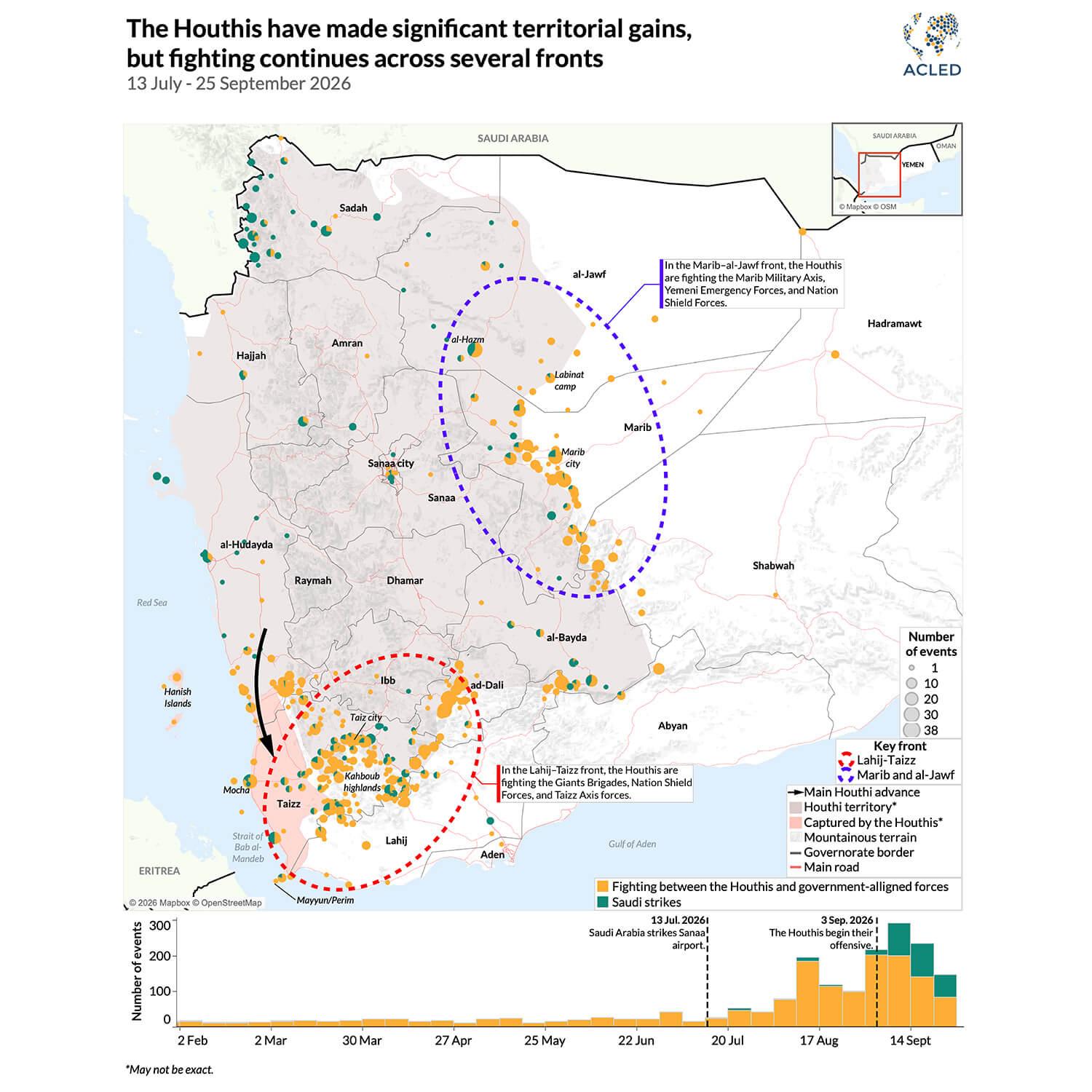
The Kahboub highlands are now central to whether the Houthis can consolidate their coastal gains: Control would provide defensive depth and strengthen their position overlooking Bab al-Mandab. Continued Houthi pressure farther east also threatens the Taizz-Aden road, the main supply route connecting Taizz with government-held southern Yemen, while Marib remains strategically important for its oil and gas resources and access toward eastern Yemen.
Houthi strikes are increasing the cost of confrontation for Riyadh
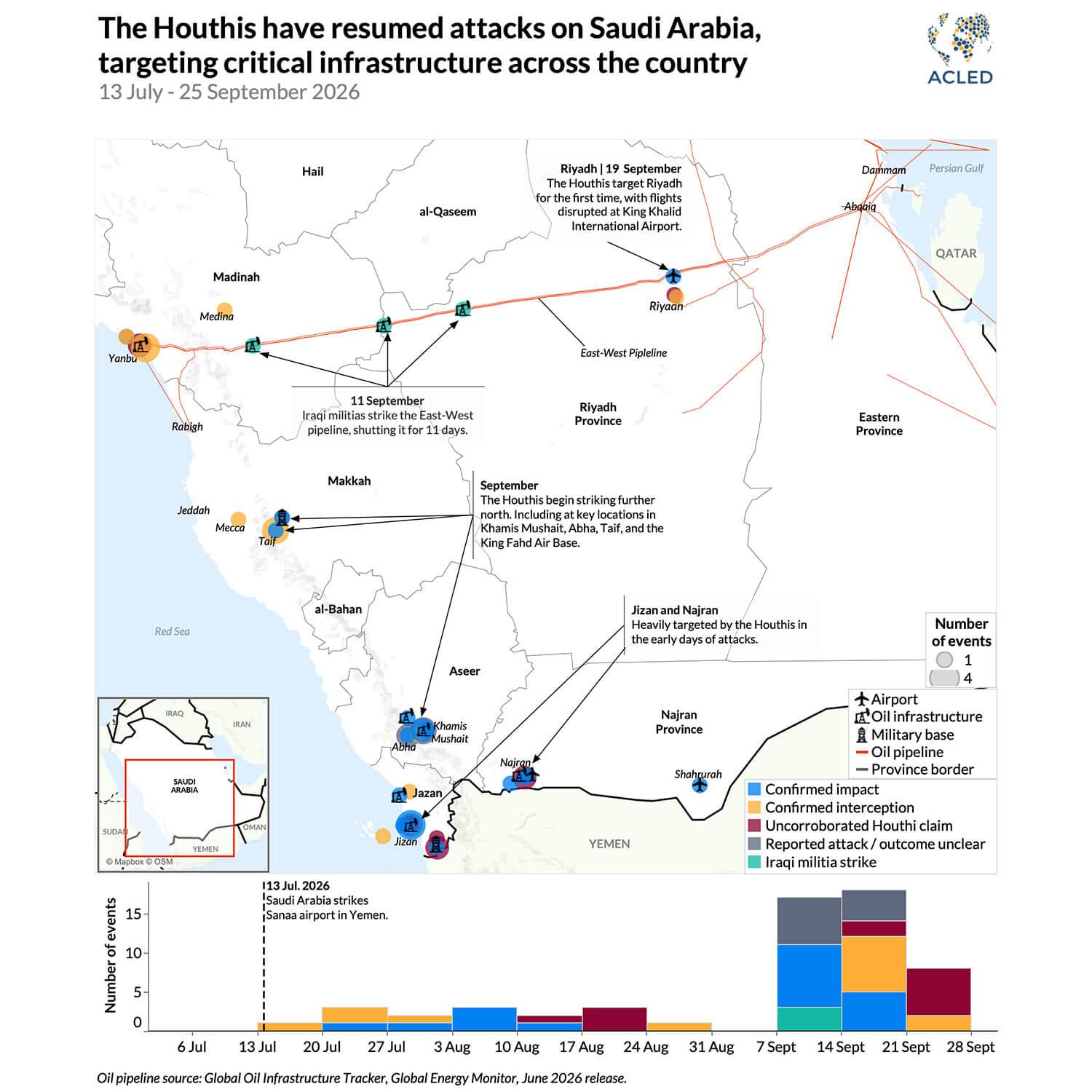
Between 13 July and 25 September, ACLED records Houthi or suspected Houthi missile and drone attacks against Saudi Arabia over 25 days. Energy infrastructure was the most frequent critical infrastructure target, followed by aviation infrastructure. Attacks also caused civilian casualties and property damage across multiple locations.
The renewed campaign began on 13 July with an intercepted Houthi missile attack targeting Abha International Airport. Subsequent attacks concentrated in southern Saudi Arabia, particularly around Jizan and Najran. Houthi attacks destroyed a crude-storage tank at Aramco’s Jizan bulk plant in July, damaged the Jizan refinery, and disrupted radar operations at Najran airport.
By September, attacks were reaching farther north and increasingly involved larger missile and drone salvos. The 8 September strike wave, which targeted Khamis Mushait, Abha, and other locations, injured 73 civilians, while an attack on King Fahd Air Base on 17 September damaged an Italian Eurofighter. On 19 September, the Houthis targeted Riyadh for the first time in the current escalation; Saudi authorities said the missile targeting the capital was intercepted, but flights were disrupted, and footage showed smoke and flames near King Khalid International Airport. The Houthis again claimed an attack on Riyadh on 24 September.
The Houthis' strike pattern has also evolved: August attacks were predominantly drone-led against nearby energy and aviation targets, while September saw more ballistic missiles and combined missile-drone attacks against deeper, more dispersed targets. Saudi defenses intercept many incoming weapons, especially at longer range, but repeated attacks still impose costs through interceptor expenditure, falling debris, emergency alerts, and disrupted aviation operations.
Riyadh faces an asymmetric exposure problem: its energy infrastructure, airports, military facilities, and ports offer the Houthis a broad target set, while relatively low-cost drones and longer-range missiles can impose disproportionate defensive and economic costs (see map below). The risk is particularly consequential along the Red Sea coast, where Yanbu and other western export infrastructure have become increasingly important to Saudi energy security. Disruption around the Strait of Hormuz has increased the importance of these alternative export routes, while a drone attack launched from Iraq on 11 September demonstrated the vulnerability of the East-West Pipeline by shutting it for 11 days. This increases Saudi incentives to avoid a prolonged confrontation while strengthening the Houthis’ leverage in negotiations, even as their territorial gains make accommodation more strategically costly.
Houthi maritime campaign has resumed, while the targeting has narrowed
Since announcing a blockade of Saudi-linked shipping in July, the Houthis have focused attacks on vessels they define as Saudi-linked, while stating that other shipping can transit freely if governments stay out of the conflict.
They have attacked 10 commercial ships, the majority of which are tankers. At least six were successfully struck. The most serious attacks sank the MSV Faize Noore Oliya on 4 August and killed four crew members aboard the Tihama on 11 August. The Houthis targeted ships in the Red Sea, along both the Saudi and Yemeni coasts, in the Strait of Bab al-Mandab, and in the Gulf of Aden (see map below). Seven targeted ships either flew under a Saudi flag or belonged to a Saudi company. Of the remaining three, the Houthis claimed Saudi links for two.
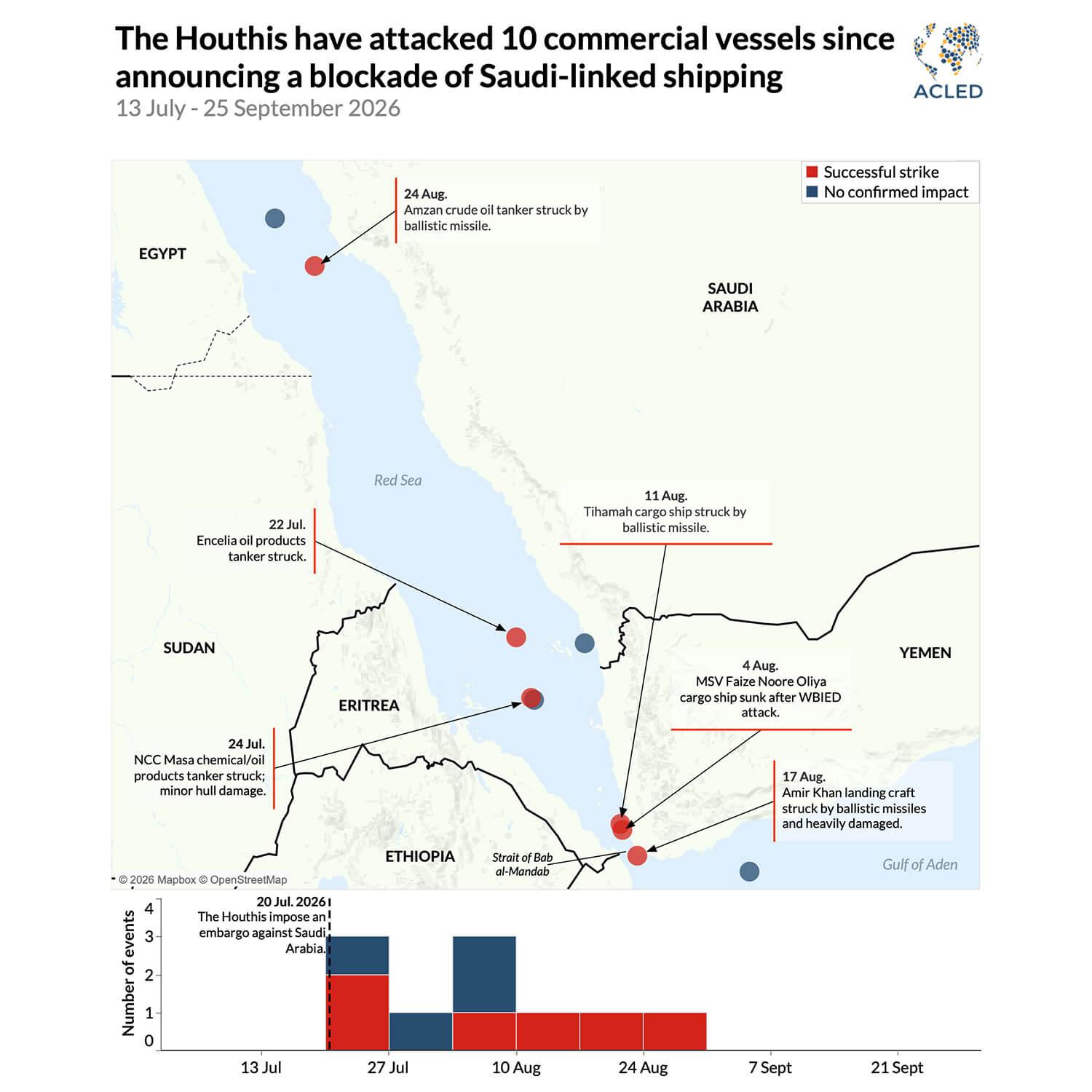
No corroborated maritime attacks have occurred since 24 August. Possible explanations for this pause include a reduced pool of Saudi-linked targets following a shift in Saudi exports from Yanbu back toward Gulf terminals and the Strait of Hormuz, greater use of rerouting and dark transits, and a Houthi calculation that attacks on Saudi infrastructure are currently generating sufficient pressure without simultaneous escalation at sea.
The narrower target set reduces the immediate risk of generalized disruption compared with the Houthis’ 2023–2025 campaign, in which they targeted a wider pool of commercial shipping in addition to Israeli, British, and US-linked vessels, but significant uncertainty remains over which vessels the Houthis may consider Saudi-linked. Ownership, management, cargo, port calls, and corporate relationships can all create potential associations, while the Houthis retain the ability to broaden their criteria as political conditions change. This risk is amplified by disruption around the Strait of Hormuz, which has increased the strategic importance of Red Sea shipping and could magnify the commercial impact of any renewed Houthi maritime escalation. The current restraint appears tactical, intended to limit the risk of broader international intervention, and should not be understood as moderation.
Outlook: Houthi gains are likely to harden into an unstable new equilibrium
The September territorial shift is likely to persist over the next three months, although the emerging balance can still be reshaped by further battlefield escalation, changes in external involvement, or a revival of diplomatic efforts. The commercial consequences will depend on whether the Houthis widen their maritime target set and whether disruption around Hormuz continues alongside insecurity around Bab al-Mandab.
Conflict scenarios over the next three months
Most likely: Houthi gains endure as fighting continues
The broad territorial shift created in September is most likely to persist, although individual positions may continue to change hands. Anti-Houthi forces are resisting more effectively around the Taizz-Lahij highlands, but fragmentation and uneven coordination make a large-scale reconquest difficult. The Houthis would be unlikely, though, to make another rapid breakthrough as supply lines lengthen and resistance around key positions strengthens. Saudi-Houthi aerial attacks are likely to continue, with Houthi missile and drone strikes on Saudi territory and Saudi strikes on Houthi positions sustaining pressure on both sides.
Under this scenario, the Houthis will entrench their surveillance and logistics advantages around Bab al-Mandab. For shipping, this means a more persistent threat rather than continuous disruption: commercial traffic is likely to continue but with higher insurance, security, or rerouting costs, while Saudi export routes remain at heightened risk of disruption in the Red Sea and the Strait of Hormuz
Lower probability: Coordinated counteroffensive reverses significant Houthi gains
A reversal of some September gains would require a material improvement in anti-Houthi coordination alongside sustained external support, particularly Saudi air support and pressure on Houthi supply lines. Many of the Houthis’ newly acquired coastal positions are more exposed than their traditional mountain strongholds, making some territory difficult to hold under sustained pressure. Saudi Arabia is already seeking to improve coordination among anti-Houthi forces, but persistent divisions within the anti-Houthi coalition continue to constrain its ability to mount a sustained counteroffensive. A significant rollback, therefore, remains a lower-probability outcome over the next three months.
Even with territorial losses around Bab al-Mandab, however, the Houthis will retain missiles, drones, and unmanned maritime systems. Maritime risk will remain elevated in the near term as intensified military operations and Houthi retaliation would increase threats to Saudi shipping, aviation, and energy infrastructure.
High-impact, less likely: Foreign support shifts from defensive assistance to direct intervention
Foreign military support for Saudi Arabia and Red Sea security is already expanding, but remains predominantly defensive. The United States has so far declined requests for direct military intervention, with Trump reportedly calling off proposed strikes against the Houthis, while British support has remained limited to defensive refueling. The August Saudi-Turkey-Pakistan defense pact has so far translated into closer military coordination and defensive support rather than combat operations in Yemen, as Ankara and Islamabad seek to avoid deeper involvement in the wider regional conflict.
Direct foreign intervention, therefore, remains unlikely over the next three months, but further Houthi territorial gains, a damaging strike on critical Saudi infrastructure, or a widening of maritime attacks would increase pressure on Saudi partners to move beyond defensive assistance
Expanded defensive support can limit damage and help keep Bab al-Mandab open. But direct intervention carries much greater escalation risks, most likely prompting retaliation against participating states or wider categories of shipping. The commercial impact would be greatest if increased insecurity around Bab al-Mandab coincided with continued disruption around Hormuz, raising oil, freight, and insurance costs.
De-escalatory scenario: Diplomacy restores partial restraint
A prolonged battlefield stalemate is likely to strengthen incentives for ongoing UN- and Omani-mediated diplomatic efforts to produce a reduction in cross-border and maritime attacks without producing a broader political settlement. Riyadh has strong incentives to protect its energy infrastructure and export routes, while the Houthis may prefer to consolidate their gains rather than provoke deeper foreign intervention.
This scenario remains less likely over the next three months than a continued confrontation. The Houthis’ stronger territorial position has increased their bargaining leverage and is likely to raise their demands for wider economic and political concessions, potentially including limits on Saudi support for Yemeni rivals. Riyadh, meanwhile, is unlikely to accept an arrangement that entrenches Houthi control of the Red Sea coast without constraining their missile, drone, and maritime capabilities. Any near-term agreement is therefore more likely to produce limited reciprocal restraint than a broader political settlement. Such restraint could still reduce pressure on Saudi exports, insurance, and freight costs, but will remain vulnerable to a breakdown in negotiations or renewed regional escalation.
Annex: Key armed actor overview
Two rival governments have controlled Yemen since the country’s civil war broke out in 2014. The Iran-backed Houthis rule most of the northwestern part of the country and most of the population from Sanaa, while the anti-Houthi, Saudi-backed PLC officially rules the remainder of the country from Aden city as the Internationally Recognized Government (IRG). As the conflict developed over the years, various groups in the anti-Houthi camp formed, disbanded, or merged. By 2026, all major anti-Houthi forces officially came under the PLC umbrella and the IRG’s army, including the National Resistance Forces, the Southern Giants Brigades, the Nation Shield Forces, and the Yemeni Emergency Forces.
Houthi actor
| Actor | Key leaders / Commanders | Fighter numbers | Allies | Ideology | Key role / Areas of activity |
|---|---|---|---|---|---|
| Yemeni Armed Forces (Houthi) | Abdulmalik al-Houthi (Houthi leader); Yusuf al-Madani (chief of staff) | ~ 350,000 | Iran | Zaydi Shiite politico-religious movement; Axis of Resistance | Governance over northwestern Yemen, including the Red Sea coast |
Anti-Houthi actors
| Actor | Key leaders / Commanders | Fighter numbers | Allies | Ideology | Key role / Areas of activity |
|---|---|---|---|---|---|
| National Resistance Forces (NRF) | Tariq Saleh | 20,000 - 65,000 | Saudi Arabia (formerly UAE) / PLC | Republican / Saleh family-aligned | Red Sea coast – al-Hudayda and Taizz governorates – and neighboring Lahij governorate |
| Southern Giants Brigades (SGB) | Abdalrahman al-Mahrami | 15,000 - 90,000 | Saudi Arabia (formerly UAE) / PLC | Salafist and tribal (southern governorates) | Widespread deployment throughout Yemen, except for the northern and eastern governorates. Especially active in Lahij, al-Dali, and Taizz governorates |
| Nation Shield Forces (NSF) | Bassam Mahdhar al-Sanabi | 30,000 - 45,000 | Saudi Arabia / PLC | Salafist and tribal (southern governorates) | Security of southern Yemen. Recently deployed to the northern al-Jawf governorate |
| Yemeni Emergency Forces (YEF) | Falah al-Shahrani (Saudi Commander) | 20,000 - 35,000 | Saudi Arabia / PLC | Salafist and tribal (northern governorates) | Border defense along the Yemeni-Saudi border |
| Yemeni Armed Forces (IRG) | Saghir Hamud Aziz (overall chief of staff) | 300,000 - 400,000 | Saudi Arabia / PLC | Republican / Islah-aligned factions | Officially the Armed Forces of the IRG, but mostly active in the northern governorates, as well as Taizz and Marib, often supported by local tribes |
Restricted page:
Yemen Conflict Monitor
As the country’s complex conflict landscape continued to evolve and with the prospect of a political settlement on the horizon, ACLED established the Yemen Conflict Observatory, which was later renamed the Yemen Conflict Monitor (YCM). It is a platform offering an array of analytical tools and products to help users stay up to date on the latest developments as the war rages again.
Explore further


