
Report
Settler violence in the West Bank hits record levels as farming outposts expand
Violence is likely to remain high beyond the October elections as the Israeli government continues supporting settlement and outpost expansion.

Executive summary
Outposts and farming outposts have expanded quickly in the West Bank as a result of the Israeli government’s pro-settler policies. This has resulted in violence spreading into more rural areas. Settlers have also become more heavily armed and more involved in local security structures. At the same time, weak law enforcement has kept accountability low, while international pressure has had a limited effect. Settler violence has concentrated around new outposts and farming areas established near rural Palestinian communities of Area C and B across the West Bank, mainly in the governorates of Hebron, Ramallah and al-Bireh, Nablus, and Jenin.
Ahead of Israel’s elections, scheduled for October, settler violence is likely to increase. If the current coalition stays in power, violence is likely to increase in rural communities located near Area C and B and spread further as outposts continue to expand. Even under a different administration’s policies, farm outposts, armed local security structures, and a settler presence built up under the current Netanyahu-led government would be difficult to reverse. Effective law enforcement and sustained international pressure could slow the trend, but a major decline in violence is unlikely.
Settler violence has reached record levels under Israel’s current government
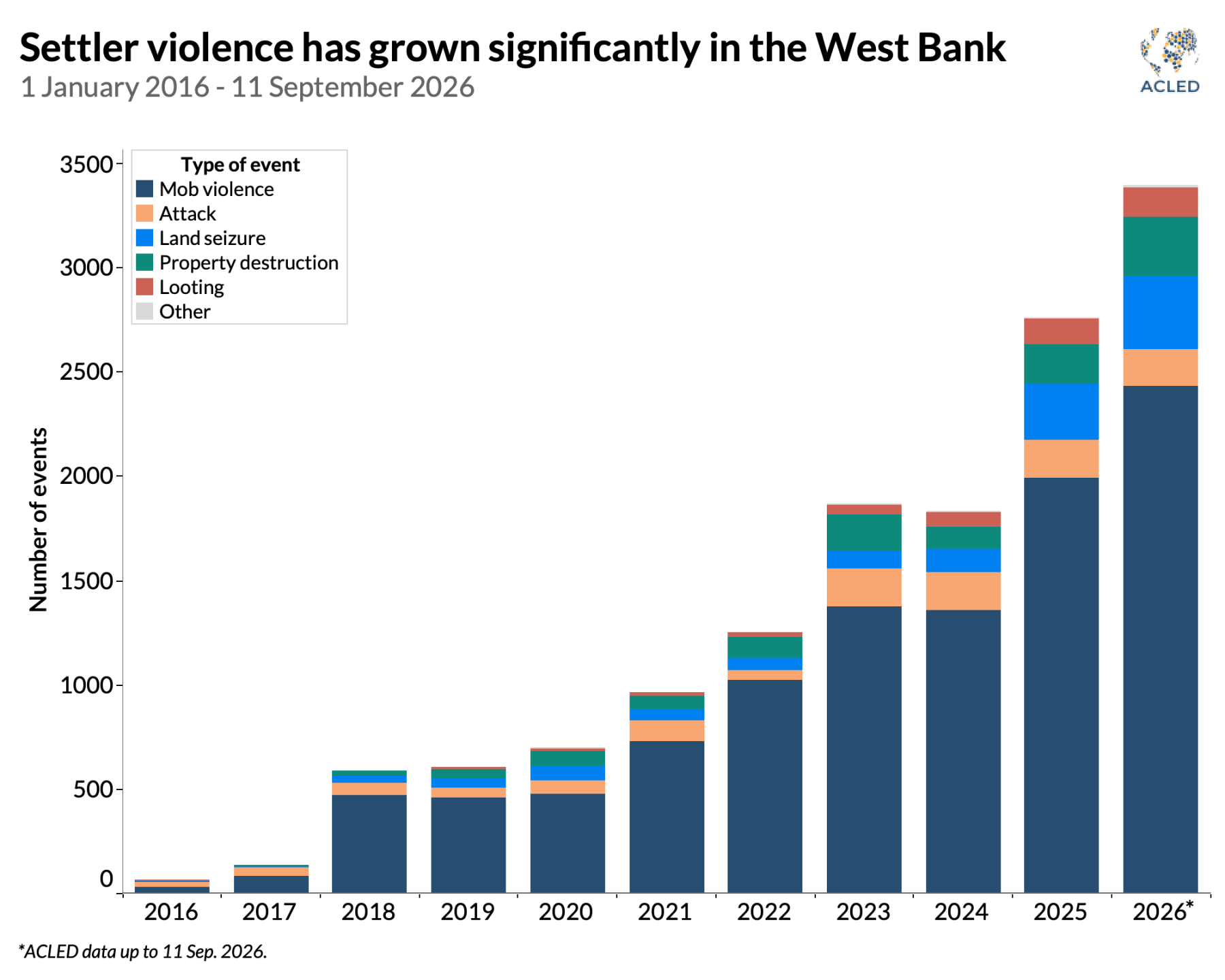
Since the current Netanyahu-led Israeli government took office on 29 December 2022, settler violence against Palestinians and their property has increased sharply. This increase has most notably accelerated since 2025 (see chart below), and 2026 is already the most violent year since ACLED began monitoring the West Bank in 2016. While daily friction between settlers and Palestinians continues to drive mob violence, other forms of violence have also risen sharply, including attacks, land seizure, looting, and property destruction.
Armed settler violence, previously a rare form of violence, has become more frequent and deadly since 2023 (see table below). ACLED records 158 incidents involving settlers firing weapons in 2023, compared with 48 in 2022. During nearly eight months of 2026, the number had already reached 203, the highest level recorded since 2016. These incidents include direct shooting attacks and cases in which settlers have opened fire during mob violence clashes. Among them have been cases in which soldiers have joined settlers in shooting or participating in violence.
Number of settler shooting incidents and fatalities by year, including cases involving Israeli forces
| Year | Number of shooting events | Fatalities |
|---|---|---|
| 2023 | 158 | 11 |
| 2024 | 156 | 8 |
| 2025 | 185 | 12 |
| 1 January - 11 September 2026 | 203 | 26 |
| Total | 702 | 57 |
This trend has been exacerbated by the greater integration of armed settlers into local security structures in settlements and outposts. Since the 7 October 2023 attack, Israel’s multi-front war has stretched the Israel Defense Forces’ (IDF) attention and manpower, which has increased reliance on local defense arrangements. By December 2025, at least 500 settler soldiers from regional defense units, or Hagmar, were still deployed to farm outposts. Meanwhile, Israel’s institutions have enabled settler violence by not holding violent settlers accountable. Since 2005, nearly 94% of investigation files against settlers have been closed without indictment, while only 3% have led to a conviction.
The growth of farm outposts drives the surge in violence
The surge in settler violence has been driven by the rapid expansion of farm outposts. Peace Now data show that settlers established 259 new outposts between 2023 and 1 August 2026, including 186 farming outposts. The same data also show that, in nearly seven months of 2026, settlers have created 57 farm outposts, accounting for about 31% of all farm outposts established since January 2023 (see table below). While most outpost expansion has occurred in Area C, the area in the West Bank under full Israeli security and administrative control, settlers have established at least 20 farm outposts since 2024 in Area B, which is under Israeli security control and the Palestinian Authority’s (PA) administrative control, including 12 in the first seven months of 2026. Farming outposts are particularly important because a small number of settlers can establish a presence over large areas of surrounding land. Settlers now control more than 1.1 million dunams, or around 1,100 km in Area C, roughly one-third of the area.
New settler outposts by type and year1
| Year | Farm outposts | Outposts | Total |
|---|---|---|---|
| 2023 | 24 | 8 | 32 |
| 2024 | 43 | 18 | 61 |
| 2025 | 62 | 30 | 92 |
| 1 January - 11 September 2026 | 57 | 17 | 74 |
| Total | 186 | 73 | 259 |
New outposts have brought settlers closer to Palestinian villages and communities, including in Areas A and B, where the PA has administrative control, which has created new flashpoints. In several communities that experienced no settler violence between 2016 and 2022, repeated incidents of settler violence have taken place after new outposts were established nearby. For example, 35 incidents of settler violence have taken place in Marj Siya in Ramallah and al-Bireh governorate in 2026 after several new outposts were established nearby. Thus far in 2026, 49% of settler violence events have occurred within 3 km of a new farming outpost established this year. Between 2023 and 2026, incidents of settler violence within 3 km of new farming outposts have increased more than fourfold. This trend suggests that settler violence has not spread evenly across the West Bank but has become more concentrated around rural communities (see chart below). Violence carried out by settlers has included attacks on farmers and herders, destruction of olive trees and crops, land seizure, settlers grazing livestock on Palestinian land, and the looting of crops and livestock.
Settler violence that occurs alongside the expansion of farming outposts has therefore become a wider tool of economic pressure on Palestinians in rural areas. Losing access to land has weakened livelihoods, increased the risk of displacement, and pushed communities to leave. ACLED data show that Palestinian communities and groups of shepherds have been displaced in eight locations between January and 11 September 2026, including the Bedouin community in al-Awja near Jericho and farming communities in the Tubas governorate, such as Khirbet Yarza.
Geographically, violence has spread into more locations while remaining concentrated in rural communities. In the first eight months of 2026, settler violence affected 397 locations across the West Bank, 75% more than in 2022. The governorates of Hebron, Ramallah and al-Bireh, and Nablus are the most affected by settler violence (see maps below). These three governorates account for about 74% of the increase in the number of affected locations between 2025 and 2026. They have large Palestinian populations and many villages located in areas A and B close to Area C, where most outpost expansion has taken place. The sharpest increase has taken place in the governorate of Jenin, where the number of affected locations have doubled from 12 in 2025 to 24 between January and 11 September 2026.
Outlook: Settler violence is likely to grow and spread further even after the elections
Settler violence is likely to grow in the next three months, as Israel’s government continues to prioritize settlement and outpost expansion in the West Bank. Violence will likely concentrate around new outposts and farming areas that are likely to continue expanding in rural communities of Area C across the West Bank, mainly in the governorates of Hebron, Ramallah and al-Bireh, Nablus, and Jenin. The growing role of armed settlers in local security structures will keep the risk of shootings and fatalities high.
The election of a settler-aligned Likud-led government, such as Smotrich and Ben-Gvir, in the coming October elections is likely to continue these trends. A different government led by opposition figures such as Gadi Eisenkot or Naftali Bennett is likely to struggle to reverse the outposts and armed local structures that have been built since 2023. However, stronger law enforcement against settler violence and sustained international pressure could slow the trend, but a sharp drop in violence is unlikely in the next three months.
Factors that will shape further expansion of settler violence
Israeli government policy and political continuity: The Israeli government is likely to continue supporting settlement and outpost expansion to exert greater control over land as part of its ideology and security policy. A change in government is unlikely to reverse developments since 2023, as its policy will likely rely on greater territorial control as part of Israel’s security approach in the West Bank.
Arming of settlers: The risk of shootings and fatalities in the West Bank will remain high as the Israeli government’s reliance on armed settlers, civilian security squads, and Hagmar reservists is likely to continue. This reliance remains important as the IDF continues to operate on several fronts and faces a manpower shortage. Conversely, if Israeli forces were to re-engage in the West Bank and exert tighter control on settlers’ weapons, this is likely to reduce the risk of further violence. This scenario is unlikely, however.
Law enforcement: Weak law enforcement and prosecution for creating illegal outposts and carrying out settler attacks have kept the cost of carrying out this violence low. Stronger law enforcement could reduce violence and limit further expansion, but this would require a government with a different political mandate, which is unlikely to materialize.
Annex
Number of locations affected by settler violence in each governorate, by year
| Governorate name | 2023 | 2024 | 2025 | 20262 |
|---|---|---|---|---|
| Hebron | 55 | 72 | 68 | 77 |
| Ramallah and Al Bireh | 53 | 58 | 63 | 76 |
| Nablus | 50 | 58 | 60 | 70 |
| Bethlehem | 27 | 31 | 33 | 33 |
| Tubas | 16 | 24 | 26 | 27 |
| Al Quds | 22 | 18 | 21 | 26 |
| Jenin | 9 | 16 | 12 | 24 |
| Salfit | 25 | 26 | 26 | 24 |
| Jericho | 10 | 9 | 16 | 17 |
| Qalqilya | 15 | 14 | 17 | 14 |
| Tulkarm | 10 | 9 | 12 | 9 |
| Total | 292 | 335 | 354 | 397 |
Settler violence near outposts established in the same year3
| Year | Events involving settlers | Number of events within 1 km of a new outpost | Number of events within 1.1 - 3 km of a new outpost | Number of events within 1 km of a new farming outpost | Number of events within 1.1 - 3 km of a new farming outpost |
|---|---|---|---|---|---|
| 2023 | 1,865 | 5 | 100 | 25 | 357 |
| 2024 | 1,833 | 30 | 217 | 46 | 462 |
| 2025 | 2,763 | 35 | 766 | 224 | 1,149 |
| 1 January - 11 September 2026 | 3,395 | 18 | 359 | 239 | 1,422 |


