
Report
Turkey’s PKK peace process is likely to strengthen the PJAK in its confrontation with the Islamic Republic
PKK disarmament may redirect resources toward the PJAK, strengthening its armed capacity against Iran and future efforts to challenge the regime.

Executive summary
Turkey’s Kurdistan Workers’ Party (PKK) disarmament process will likely strengthen the Kurdistan Free Life Party (PJAK) indirectly by redirecting some personnel or resources through the wider Kurdistan Communities Union (KCK) system, the transnational umbrella structure linking PKK-aligned Kurdish groups across the region. In the near term, these additions — even if they are modest — will primarily help the PJAK preserve its networks, replace losses, and sustain small-unit activity inside western Iran.
The greater risk will emerge if this stronger base coincides with renewed external conflict or wider popular unrest inside Iran. The PJAK could then expand the geographic reach and intensity of its operations, stretch Iranian security forces in the west, and contribute to a broader Kurdish armed challenge. Over the next six to 12 months, the PJAK is likely to prepare for such an opening while avoiding a premature campaign that would expose its forces to a concentrated Iranian response.
PKK disarmament is likely to redirect personnel and resources toward the PJAK
Turkey formalized the PKK/KCK disarmament process through Law 7595, which was adopted on 10 August and has been in force since 18 August. The law covers all formations connected to the PKK and KCK. Although the law does not name the PJAK, Ankara has explicitly said that the wider disarmament process should include the group’s dissolution.
The PJAK and its armed wing, the Eastern Kurdistan Defense Units (YRK), have, however, rejected any suggestions that they would disarm. In an interview on 26 August, spokesperson Rivar Abdanan said the group would retain an armed capacity for what it considers legitimate self-defense. According to an official Turkish parliamentary transcript, PKK founder Abdullah Öcalan told the commission in November 2025 that the PJAK would remain armed as long as executions continued in Iran, although he endorsed dialogue and an eventual political settlement.
While the PJAK presents itself as an autonomous Iranian Kurdish organization, it operates within the wider transnational KCK system across Turkey, Iran, Iraq, and Syria. As such, personnel move across national and organizational boundaries within this system. Of the four YRK fighters killed in clashes with Iran’s Islamic Revolutionary Guard Corps (IRGC) near Mahabad in June, two were from Kurdish areas of Turkey and two from Iran. In recent years, Turkey has repeatedly targeted PJAK and YRK members and positions in northern Iraq, including personnel who previously served in PKK structures. Turkish security sources said that Islam Dotkanlou, who was killed in Sulaymaniyah in January 2025, joined the PKK before founding the YRK. They similarly reported that Hatice Hezer, killed in Sulaymaniyah in 2022, joined the PKK in 1991 before taking up leading positions in the PJAK and its female military wing. Between 2020 and 2025, ACLED records at least 25 Turkish air- or drone attacks against individuals or positions linked to the PJAK or YRK.
This organizational and personnel overlap within the KCK can allow individual cadres to move between roles, while weapons and communications equipment can be transferred, and existing routes, tunnels, shelters, and other logistical assets in northern Iraq could support operations toward the Iranian frontier. The PJAK nevertheless publicly rejects this possibility. Its spokesperson said in August that the PKK’s dissolution had no direct connection to the PJAK and argued that PKK members should return to civilian politics. Turkish Defense Minister Yaşar Güler nevertheless suggested last December that Turkey had detected attempted movements of PKK personnel, weapons, and ammunition from northern Iraq toward Iran.
The PJAK retains an operational presence inside Iran
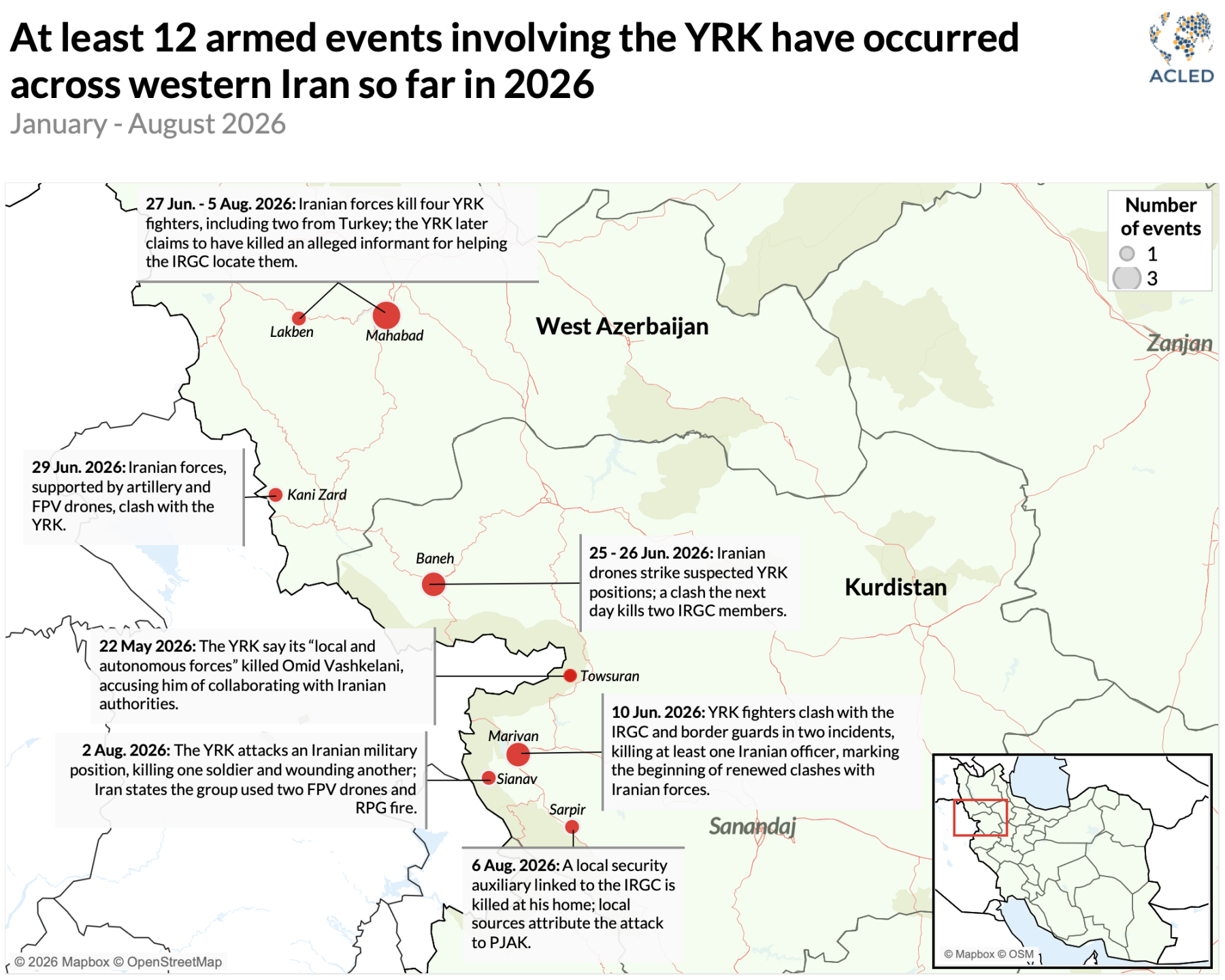
The PJAK is generally regarded as the most operationally capable of the Iranian Kurdish opposition groups. While a 2011 ceasefire reduced the group’s conflict with the Islamic Republic’s security forces, the group was involved in nearly 60% of armed events inside Iran involving an identified Iranian Kurdish opposition group in the past decade. The YRK maintains mobile units in western Iran across several border areas with support from clandestine local networks and recruitment channels. ACLED records 12 armed events involving the YRK in 2026, already the highest annual total since ACLED’s coverage of Iran began in 2016 (see graph below).
Targeted killings of what the PJAK suggests to be informants and local security auxiliaries form part of the group’s effort to protect its clandestine presence in Iran. In May, the YRK announced that its “local and autonomous forces” killed a man near the border town of Marivan and accused him of collaborating with Iranian authorities. In August, the YRK claimed responsibility for killing another man, alleging that he helped the IRGC locate four YRK members who were then killed near Mahabad in late June, and warned that other identified collaborators would be pursued. These statements point to counterintelligence by coercion: removing suspected sources while deterring others from supplying the local intelligence Iran needs to track mobile units. The reference to local forces also suggests that the YRK drew on embedded elements beyond the YRK’s mountain units. The losses suffered in Mahabad nevertheless show that Iranian forces retain the ability to penetrate or detect these networks.
Recent YRK activity also indicates that the group is experimenting with new tactics. The YRK claimed responsibility for a deadly attack on a military position near Marivan on 2 August (see map below), in retaliation for Iranian forces’ killing of three members of a Kurdish family six days earlier. Iran’s army said the attackers used two one-way attack drones alongside rocket-propelled grenade (RPG) fire, which killed one soldier and wounded another. Repeated drone use would indicate that the YRK is incorporating low-cost aerial systems into its small-unit tactics.
Outlook: The PJAK will consolidate while preparing for a broader opening inside Iran
Over the next six to 12 months, the PJAK-Iran conflict will likely remain characterized by episodic small-unit activity as the PJAK reinforces its clandestine networks inside western Iran. Any redistribution of personnel or resources through the KCK is likely to remain limited, as Turkish monitoring would make large or organized transfers difficult to conceal. Even modest additions of experienced personnel, weapons, or equipment, however, would help the PJAK replace losses, preserve routes and communications, support local cells, and sustain attacks.
The 2026 Iran-Israel-United States war exposed the limits of a cross-border Kurdish offensive. Israel reportedly planned to send several Iranian Kurdish factions into western Iran under air cover — although the PJAK was reportedly excluded. Washington blocked the move; Turkey, Baghdad, and the KRG opposed it; and the Kurdish parties were unwilling to advance without sustained protection, resupply, and guarantees.
These constraints may shift future external efforts toward networks already inside Iran. Israel’s regime-change objective remains unchanged, while the war showed that airpower can weaken the regime without producing political change. Washington continues to consider arming domestic opposition, and Israel has been broadly calling to give Iranians the “tools to win” a future uprising. Actors seeking regime change may therefore try to cultivate armed capacity inside Iran to exploit a later opening as military, economic, and domestic pressures erode Tehran’s coercive control. The PJAK is likely to form part of such a strategy by using its local networks to recruit, monitor security deployments, sustain mobile units, and coordinate attacks across several districts without relying on a large-scale border incursion.
Key indicators that the PJAK is gaining capacity and that a wider opening for escalation is emerging
- Structured KCK redistribution: Corroborated evidence that multiple cadres have moved from PKK roles into PJAK/YRK command, training, logistics, or specialist roles, or that weapons and communications equipment have been transferred toward the Iranian frontier would indicate that PKK disarmament is translating into increased operational capacity for PJAK.
- Operational strengthening inside Iran: A sustained increase in operational activity across multiple districts, evidence of linked safe houses or communications caches, an increase in or geographic spread of attacks on alleged informants, or repeated drone use would indicate that the PJAK is developing a more resilient and geographically dispersed operational presence inside Iran.
- Iranian overstretch: Slower responses to YRK activity, gaps in border surveillance, delayed reinforcement, abandoned posts, or local defections during simultaneous unrest or external conflict would create greater scope for the YRK to expand its operations.
- Broader coordination and support: Joint operations; shared command structures; logistical cooperation with other Iranian Kurdish parties; or credible evidence of foreign intelligence, weapons, or air support would increase the PJAK’s ability to sustain and expand its operations.
Visuals produced by Ana Marco.


